A good design is sum of great engineering choices resulting a satisfactory compromise.
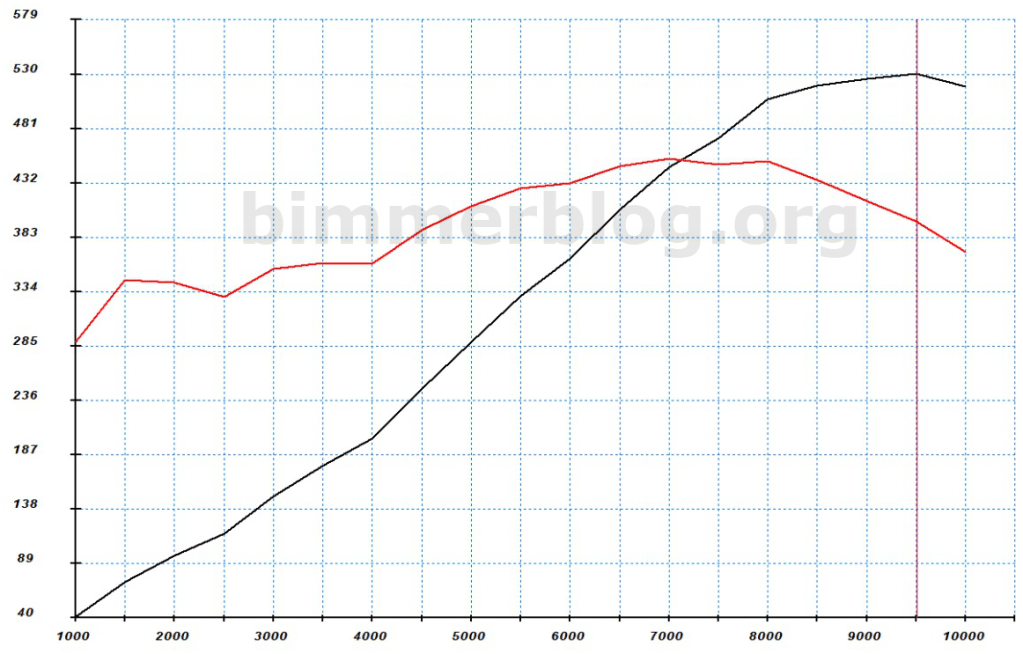
A text book like power curve on 120 hp per litre M60B44 frankenmotor.
The goal has been to design street drivable, 120hp per litre M60 engine with smooth power delivery, and reasonably good idle characteristics. Is it possible without Vanos? Please read on!
A) Bimmerblog.org designed, secret sauce camshafts,
These camshafts:
provide better idle and part throttle drivability than aftermarket cams,
are exceptionally good at reducing parasitic losses,
are suitable for up to 120hp per litre configuration,
No rollercoaster in power curve,
No risk of knocking in high compression engine.
B) Bimmerblog.org designed, individual throttle bodies (ITBs) with bellmouths:
Tapered intake runners,
55mm butterflies,
Effective runner length is 216mm,
Effective runner diameter is 53,4mm,
Relatively easy to DIY from aftermarket or OEM parts.
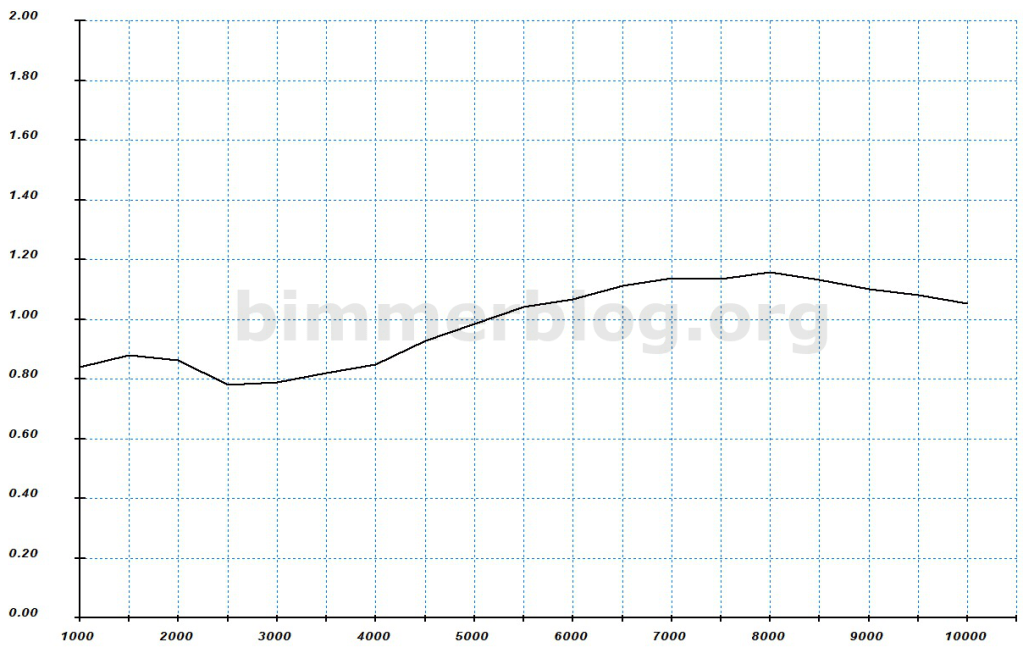
Delivery ratio peaks at 8000rpm with 216mm long runners and effective intake diameter of 53,4mm.
Other remarks:
The low end torque was not a design parameter: only the smoothness of power curve,
41mm header primaries can be deemed undersized by many,
Collectors are seen restrictive in layman’s terms, yet the negative supercharging is substantially high at 8000rpm,
ITBs and aggressive idle ignition control by Motec further improves idle quality,
Amount of scavenging for the engine has been found by trial and error, and;
This works across different cams,
Engine lifespan will be severely reduced with mean piston speed of 26,2 m/s @9500rpm,
Short stroke crankshaft is highly recommended for the application.
Bottom line:
Yes, 120hp per litre, naturally aspirated M6x engine is doable on the street. Cams, cylinder heads, headers and intake manifold have to be carefully matched together.
More information about performance upgrades can be found on my other articles:
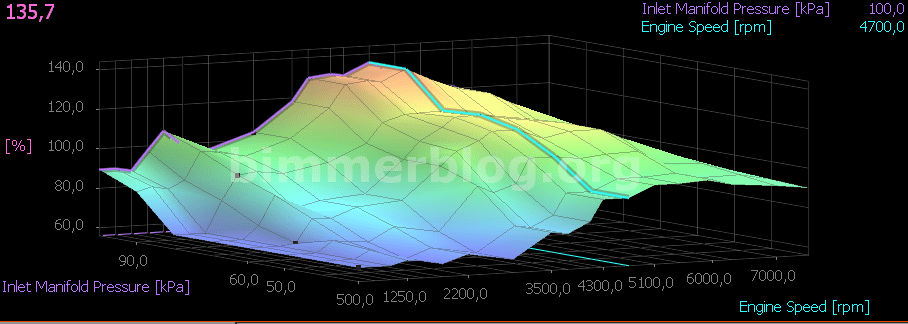
The jaw-dropping Volumetric Efficiency (VE) of 135,7% in naturally aspirated M60B44 engine.
For starters – Internal Combustion (IC) engine is an air pump
Naturally aspirated engine tuning is plain simple: (yet so ever challenging!)
A) Think your engine as an air pump,
B) Air is always moving from higher pressure to lower.
In order to increase the amount of air your naturally aspirated engine can transfer, you can:
1) Increase the size of an air pump (cc, cid),
2) Increase the effective speed of an air pump (rpm),
3) Optimize the gasdynamics for desired rpm band, such as matching cams and pressure waves with both intake and exhaust systems for optimal volumetric efficiency and scavenging effect,
4) Increase the intake air density with cooler air temperature,
5) Reduce pressure losses in the intake air path to minimum.
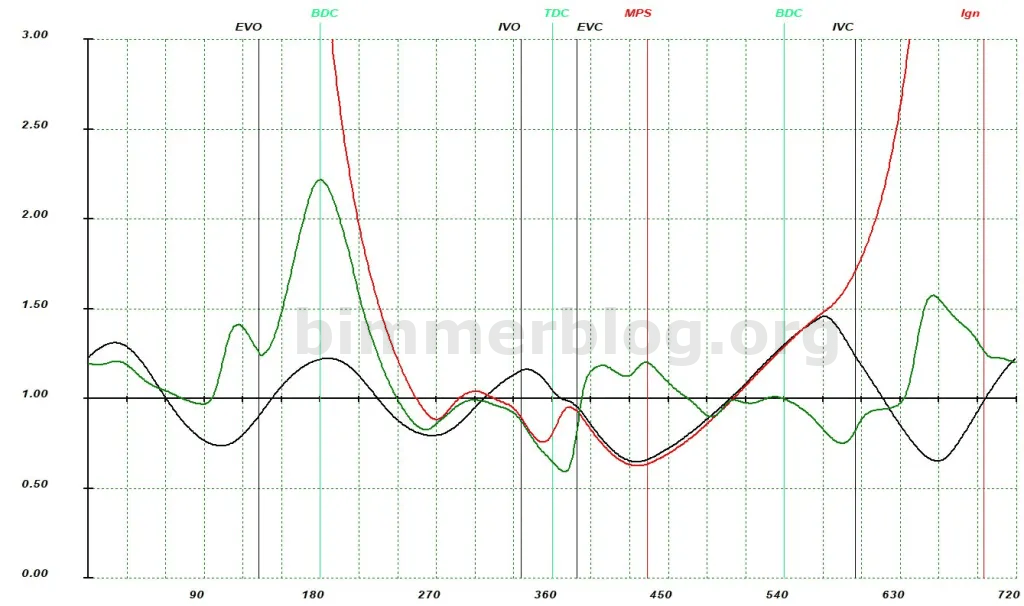
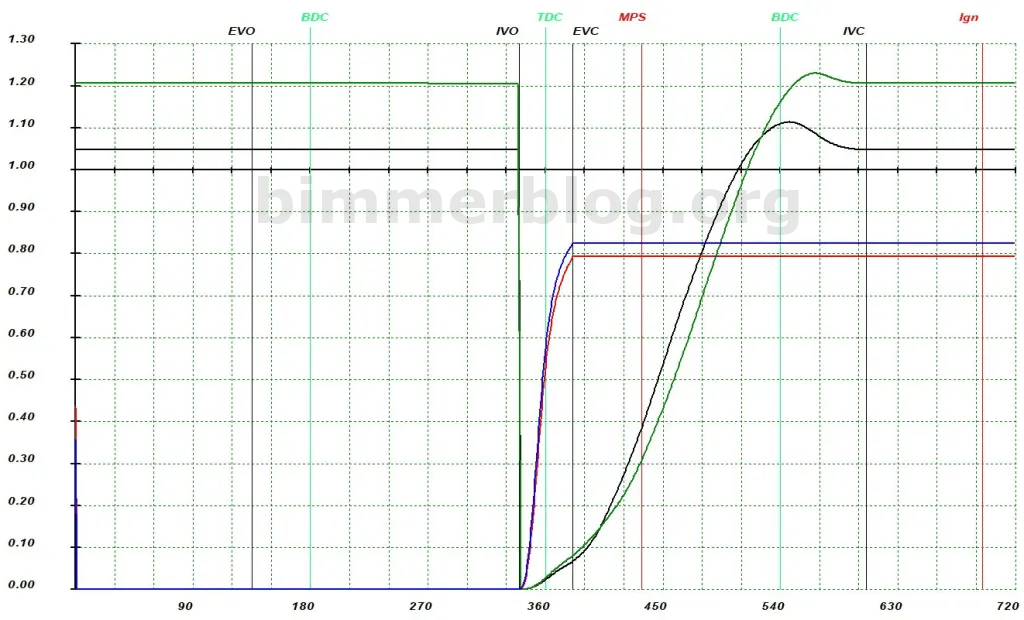
Hot street M60B44 at 4700rpm. Black line is intake pressure ratio at the intake valve. Green is pressure trace at the exhaust valve. Note the pressure differential during overlap. Red is cylinder pressure.
The Foundation of Naturally Aspirated engine: Displacement
Actually this applies for forced induction engines too. The very base foundation for HP/Torque capability is the engine displacement. Even in turbocharged applications, there is no replacement for displacement. More is better, until you hit the maximum tolerated piston speed.
Bore and stroke:
S65B40 engine with 4,0 litres has 92 mm x 75.2 mm (Bore x Stroke),
M60B40 engine with 4,0 litres has 89 mm x 80 mm (Bore x Stroke),
M62B44 engine with 4,4 litres has 92mm x 82,7mm (Bore x Stroke),
S62B50 engine with 5,0 litres has 94 mm x 89 mm (Bore x Stroke).
For comparison, Ferrari 458 engine with 4,5 litres has 94mm x 81mm (Bore x Stroke),
Rod to stroke ratios:
S65B40: 140,7mm : 75,2mm = 1,87
M60B40: 143mm : 80mm = 1,79
M62B44: 143mm : 82,7mm = 1,73
S62B50: 141,5mm : 89mm = 1,59
Mean piston speeds:
S65B40: 21 m/s @8400rpm
M60B40: 21 m/s @7850rpm
M62B44: 21 m/s @7600rpm
S62B50: 21 m/s @7000rpm
RULE 1: In naturally aspirated engine, an engine displacement will give you torque characteristics for low-to-mid rpm range. The maximum torque you can achieve is approx. 120nm per litre on NA-engine.
RULE 2: Stroke will dictate maximum tolerated piston speed, and bore how big valves you can use. Shorter stroke means less piston speed and higher revving engine – but less torque on low end.
Read on, and learn the RULE 3 below.
Maximum torque per litre, naturally aspirated engines
80 nm/l: stock 2-valve NA-engines
100nm/l: Best 2-valve NA-engines
100-110 nm/l: Modern, stock 4-valve NA-engines
110-120 nm/l The best stock, and modified 4-valve NA-engines
The character of naturally aspirated engine: Cams
“Why hotter cams 101”: If you seek for more power, you have to increase volumetric efficiency of an engine, and/or stretch the power band towards higher rpm range.
When you rev higher, the following will happen:
A) Less and less time your engine valves stays open (in milliseconds) in relation to rpm.
And;
B) Flowing gasses create more and more inertia, and fluid friction.
Take home points:
Problem A) can be tackled by assembling higher degree cams. This enable valves to stay open longer (in milliseconds) on higher rpm range.
Problem B) Increased overlap paired with good exhaust headers can take advantage of increased gas inertia. Exiting exhaust gasses in the header are creating both positive and negative pressure pulses, which can create low pressure areas, thus creating ‘scavenging effect’. OK, let’s explain this in the other words: While gasses are always looking for a route from higher pressure area to lower, during scavenging effect exhaust gasses have enough kinetic energy to keep moving forward – which in ideal situations – can create low pressure area around exhaust valve and combustion chamber during intake opening. This pressure differential can assist combustion chamber to empty burnt gasses more efficiently, while simultaneously sucking fresh air from induction system. This is called scavenging effect, and can improve your engine’s Volumetric Efficiency (VE), and produce more torque on desired rpm range. This is why you have to choose in between primary lengths for either optimal low-to-mid range torque, or maximum top end power. A note: 42mm OD primaries are fine up to 600hp!
RULE 3: In naturally aspirated engine, cylinder head flow capability in relation to engine size (cc, cid) will dictate torque characteristics for desired (Such as upper) rpm range. Number of valves, valve sizes, head porting, cam geometry – these all have an affect on volumetric efficiency(VE) for your desired rev range.
Scavenging efficiency and delivery ratio of intake system
Scavenging effect – also known as reverse or negative supercharging – is typically combined with inertial, or inertia supercharging, which in short can utilize A) kinetic energy of incoming air, and B) acoustic supercharging (rebounding resonances) in between a closing intake valve and intake manifold plenum. Model year 1992 intake manifold with proper velocity stacks has potential to high delivery ratio (DRatio) on mid range. The advantage over short ITBs can be up to 65nm on 4500rpm.
Comparison of long vs short runners on hot street M60B44 at 4700rpm. Green is model year 92 intake (with proper velocity stacks) and black are short (212mm with bell mouth) ITBs. Blue line is scavenging efficiency with 92 manifold, and red with ITBs.
Improving intake air density by eliminating the causes of heat soak
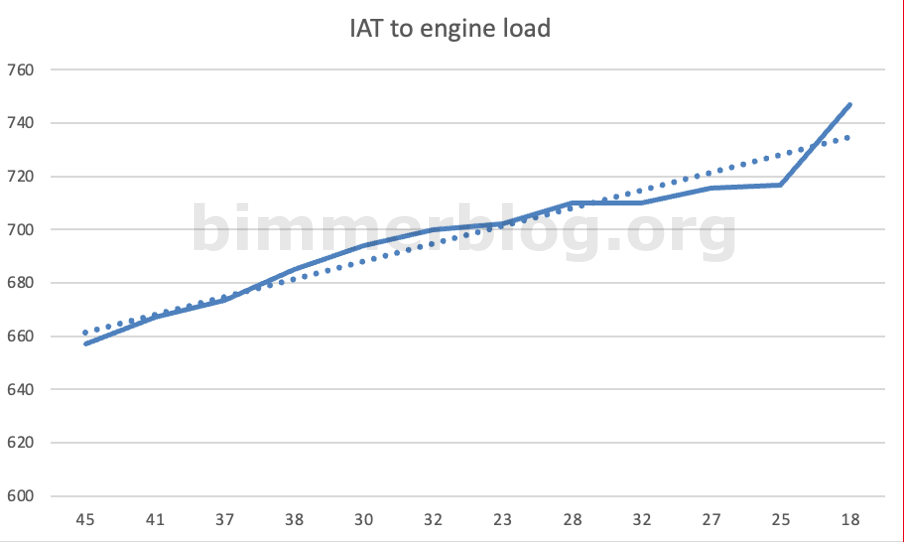
NOTE TO SELF: DIN corrected, dyno verified torque on my M60B44 engine is 113 nm per litre, measured on highly respectable hub dynamometer with DIN correction, and known for its accuracy. On street, under optimal conditions with +7 C outside temperature, the log data has shown engine loads as high as 119,4nm per litre. Please note this is NOT torque by DIN standard, only peak calculated torque from maximal engine load, hardly comparable with any other engines than my own. The difference in between dyno vs street is also due to fact the engine has very high dynamic compression, so it is(or was) suffering from heat soak while being stationary. During the dyno run the stock Intake Air Temperature (IAT) was showing temperatures up to 110 Celsius. While driving on street IAT sensor is showing +8C on top of ambient temperature, meaning IAT of 28C on street means +20C ambient temperature. The delta for inlet system temperature was staggering 82C on dyno. Since DIN corrections are based on atmospheric temperature, corrections are not taking account of temporary heat soak in the engine. The delta in inlet wall temperature was later analyzed and showing 3.8% loss in engine torque. The heat soak issue was eventually solved with less aggressive idle ignition management, combined with improved intake manifold insulation and engine cooling methodologies. The difference is not only calculative, its seat-of-the-pants noticeable on a hot summer day.
M6x engine with hollow billet cams. Emphasis on cylinder head optimization is needed for 110 nm+ per litre engine.
Reducing pressure losses in the intake manifold
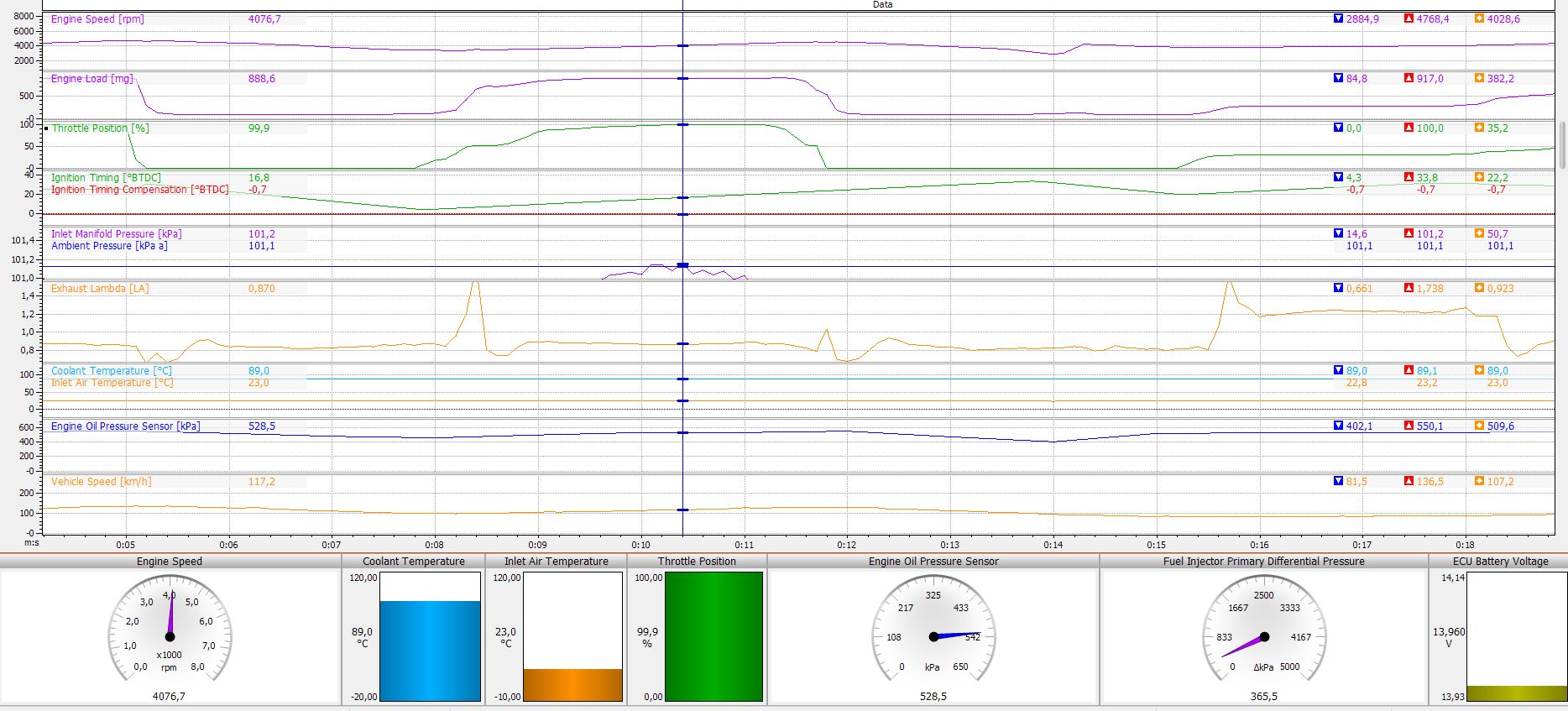
Higher intake manifold pressure than atmospheric pressure on naturally aspirated engine is rare sports. The pressure loss in the intake plenum can be minimized with RAM-air effect. There was 2 kPa pressure delta in intake manifold during the one mile run. This is not much, but states the RAM-air system works. When compared to filter on hot side, the benefit of RAM-air intake can more than 4 kPa. This kinda pressure loss is a no go for high performance, naturally aspirated engine, since they operate with such small pressure differential. MAP sensor is located at the end of intake manifold plenum. Although that being said, this data does not prove – nor deny – the existence of inertial supercharging, which can happen closer to an intake valve where incoming air can be compressed. As we learned earlier, the delivery ratio can be over 1.20 when both exhaust and intake systems are matched together, and optimized.
Examples of air intake optimizations:
Air intake on hot side, 100kPa Ambient
Air intake on hot side, 98kPa on WOT
RAM-air intake, 100kPa Ambient
RAM-air intake, 102kPa on high speed WOT
___________________
= The pressure loss (or save!) can be up to 4kPa
Log data showing minimal pressure loss, temporarily even above atmospheric pressure.
The Cold Air Intake (CAI) with RAM-air effect the market doesn’t sell
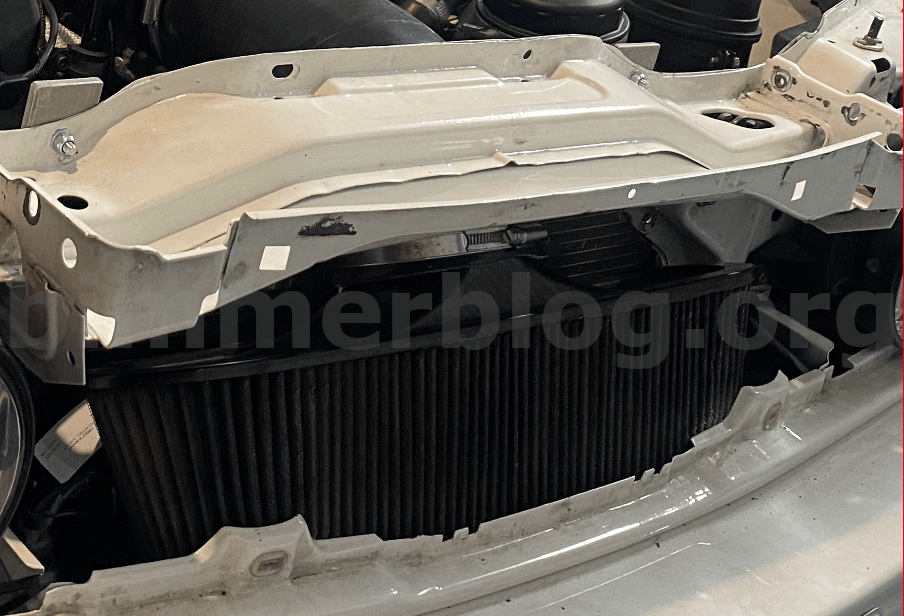
Let’s be clear: The majority of aftermarket Cold Air Intakes (CAI) do not work. They are just cool looking parts sucking hot and low pressure air under the bonnet. This is especially bad for naturally aspirated engines as stated in the previous paragraph. The filter you can use is K&N part nr. 63-3052. You can use other C6 Corvette filters too. The log data from one mile runs verifies the existence, and efficiency of the RAM-air system below.
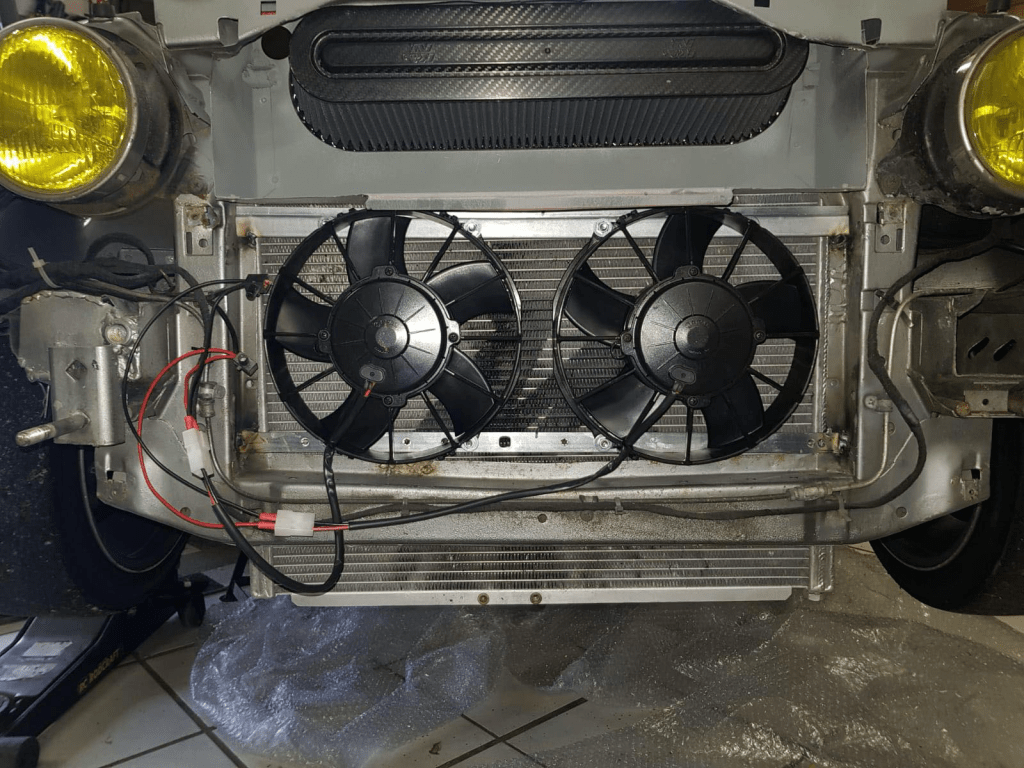
Optimized air induction system with Ram-air effect on M6x engine. This effect can increase engine load (Mg/Stroke) up to 2,5%. In Addition, there can be up to 10% reduction in engine load (torque), if your engine is sucking both hot and low pressure air from engine compartment.Race winning cold air intake system on E30 V8 by Jaschinski Motorsport. You need to lower radiator mounting points by 10 cm in order to install Corvette style CAI. Compact, and high quality cooling fans are needed to keep engine cool while idling. Note the encapsulated compartment for the filter.
About the importance of data logging and measuring
I have tested different optimization techniques based on the principles presented in this article. The baseline is initial dynorun. Mg/stroke is the engine load (Torque). The difference in engine output at 6900 rpm can be over 10% when optimizing both intake and exhaust systems. The most visible modification is Corvette style CAI with RAM-air effect. Other modifications are not visible. 7,4% difference was measured during one mile run with RAM air effect (+18C ambient temperature), and 10,4% difference with cold weather (+7C ambient temperature). Thereafter more optimizations have been implemented. The data point of 6900 rpm was selected simply by the availability of data, and due to interest in optimizing torque on upper rev range – without sacrificing low-to-mid end torque. These optimizations have made huge difference, and unlocked full potential of the engine. Fast forward to today, and possible modifications are being analyzed in advance. This can save a lot of time, money, and from disappointment.
Correlation of IAT sensor (C) and engine load (Mg/stroke).
More information about performance upgrades can be found on my other articles:
One mile acceleration is the ultimate performance car test.
1609,344 meters. One mile acceleration may never get any attention on mainstream car magazines, but in reality it is the most demanding performance test on any motor vehicle, including electric cars.
Reasons why One mile acceleration is the ultimate performance car test:
One mile acceleration creates the most demanding load on your engine vs. any other performance test such as quarter mile, 0-100km/h, or 0-200kmh etc. Prolonged heat accumulation (BTU) during the one mile run can have drastic results on your car’s performance, and durability.
Since the test is very demanding – and dangerous – it is performed only on closed tracks such as airstrips. CAUTION: Never try one mile run on public roads.
Although my car is designed as cafe racer, not on drag strip, I was interested to see what is M60B44 engine’s real world performance. On one mile run you can compare your car against a vast array of other performance cars. I was lucky to be able to test performance of my E30 on airstrip. I was planning ahead two shifting point scenarios:
The secret sauce for high performance is the torque band on rear wheel, divided by your car weight.
SCENARIO 1: Shifting on maximum torque:
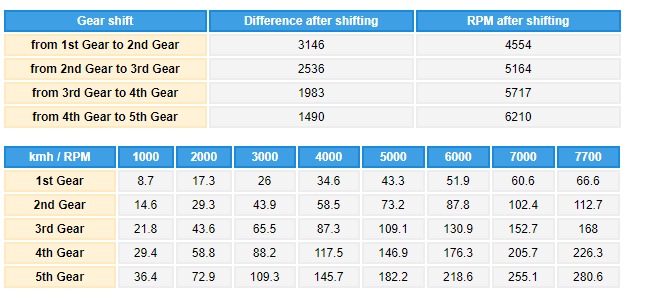
1st to 2nd gear on 7500 rpm @65 km/h,
2nd to 3rd gear on 7500 rpm @110km/h,
3rd to 4th gear on 7000 rpm @152km/h,
4th to 5th gear on 6500 rpm @191km/h,
RESULT: One mile acceleration top speed: 253 km/h @6950rpm
VERSUS:
SCENARIO 2: Shifting on maximum rpm:
1st to 2nd gear on 7500 rpm @65 km/h,
2nd to 3rd gear on 7500 rpm @110km/h,
3rd to 4th gear on 7500 rpm @164km/h,
4th to 5th gear on 7500 rpm @220km/h.
RESULT: One mile acceleration top speed: 254 km/h @7000rpm
ANALYSIS:
One km/h difference between the tests is pretty much negligible. The possible reason is increased tyre pressure after the first run. Subjectively I felt shifting is performed too late on scenario 2, although it yielded into better top speed. M60B44 engine has amazing torque band, so it really doesn’t matter when you change to fifth gear. On the same day, my naturally aspirated E30 was able to beat much higher performance cars due to 26 C weather – since turbocharged cars running on petrol were clogging due to heat accumulation. Cars running with ethanol (E85) were not facing this issue though. Tesla Model S was one of the biggest disappointment with top speed on 230 km/h range. It was pretty staggering to realize the difference in between advertised hp vs. real world performance.
PS. There was a notable side wind on the airstrip, and organisers did indeed gave a warning to motorbikes about the pesky wind. Nevertheless, I did not noted any side wind issues on E30 whatsoever, although the wind on the above video is substantial. A few really understand how seriously stable car E30 with M-technic 2 aerodynamic package is to drive at high speeds. There is so much reason why E30 is legendary. E30 is pretty much beating all never cars (read: heavier) in driving response, and feel. Due to its light weight, it just goes like a thought. It is much better than 335 M-Sport, which I did not felt comfortable at all to drive due to pesky side wind. 335 is just too heavy, rear axle gets slump, car lacks top speed stability, and it is nowhere as nimble on twisty roads as E30.
Evo2 version of M60B44 hot street engine with 7600rpm shifting point and over 500nm of torque.
M6x engine builds have gained some popularity on Youtube lately. I’m an old school fan of E30s since 90s: first naturally aspirated, then turbos, and since ’15 with different M6x configurations. I just love the engine responsiveness, amazing torque, and the sound the engine reciprocates, which makes stock M3s feel like grocery getters. Not to mention the later generation bimmers having fake engine noise from speakers. That’s just utter blasphemy for me. Since turbos are everywhere, even grannies are having at least one in their commuters, it’s so refreshing to have naturally aspirated high performance engine on street.
I’m running my car with Toyo semi slicks, and 50% limited slip differential with KW suspension. Otherwise the car is stock looking with full M-tech2 interior, and factory bodykit. The weight of the car is 1180kg (fuel tank 3/4 full), being identical to stock E30 325i. This is achievable by selecting the lightweight parts for the build, told on this blogsite. Actually you can reduce weight over 11,5kg from engine internals only! Its all about power-to-weight-ratio, power under the curve, and torque on rear wheels. By extending your engine’s usable power curve up to 7600rpm you can gain up to 160 hp on lower gear shifting point. This makes massive improvement on 0-60mph times.
By extending engine’s rev range the median power stays up while shifting. The result can be up to 160 extra hp from 1st to 2nd gear.
Stage 1: M60B40 with ported heads, headers, CAI and stock ECU
A budget swap on E30 is based on M60B40 engine, mostly due to its simplicity with both wiring harness and ECU. M60B40 is solid engine for a budget build. Just do head porting, increase compression ratio, add headers and Corvette style Cold Air Intake (CAI), and you’ll have 320hp and 450nm. Here’s Corvette-style CAI 101:
A) CAI gets air from the front, not hot air under the bonnet, and utilizes ram-air effect,
B) they are from C6 Corvette, and/or utilising the very same principle.
The other low cost option is to go with stock M62B44 engine, but they have milder cams than M60, and timing chain assembly is with single chain. M62B46, and M62B48, and S62 are also viable, but these options are expensive, and their availability is also scarce. Please remember, M62 engine family got bad timing chain and guide design, whereas M60 timing assembly with duplex chain is super solid, on par with S-engines.
Stage 2: Low budget M60B44 build with stock internals and ECU
So how about installing M60B44 engine? Hey, wait a minute! There is no official engine type such as M60B44 from the factory line. The aforementioned code simply refers to a custom built engine, utilizing the best components from both M60 and M62 engine generations. This unique combination creates a high compression engine, a ratio typically found only in S-series of engines. In the land of “what ifs”, this engine could have been rolled out from the factory as hypothetical, high power S-variant for M60 engine family. This homebrew engine modification is also know as M60B44 hybrid motor, or M60B44 frankenmotor.
First, let’s clarify one thing: If you are after a budget build, stick with a stock internals, and ECU. If you are after some serious naturally aspirated performance, you better have a good budget. Truth to be told, its far easier to get the same amount of power from a random V8 crate engine, than start tinkering with an exotic 32 valve bimmer engine. Ok, now when we are clear with this, we can proceed on how to build a serious high performance M60B44.
Stage 3: Hot street or race build with aftermarket parts and ECU
Builders are typically too focused on maximum hp numbers, and this in turn can lead to compromised low-to-mid end performance. Just a quick reminder: it’s power under the curve that matters. Be honest on what application you are building your engine for. If it’s on street, it’s for street. It really is that simple. This means your engine stays majority of its time on 1000-3000 rpm rev range. No matter your driving style.
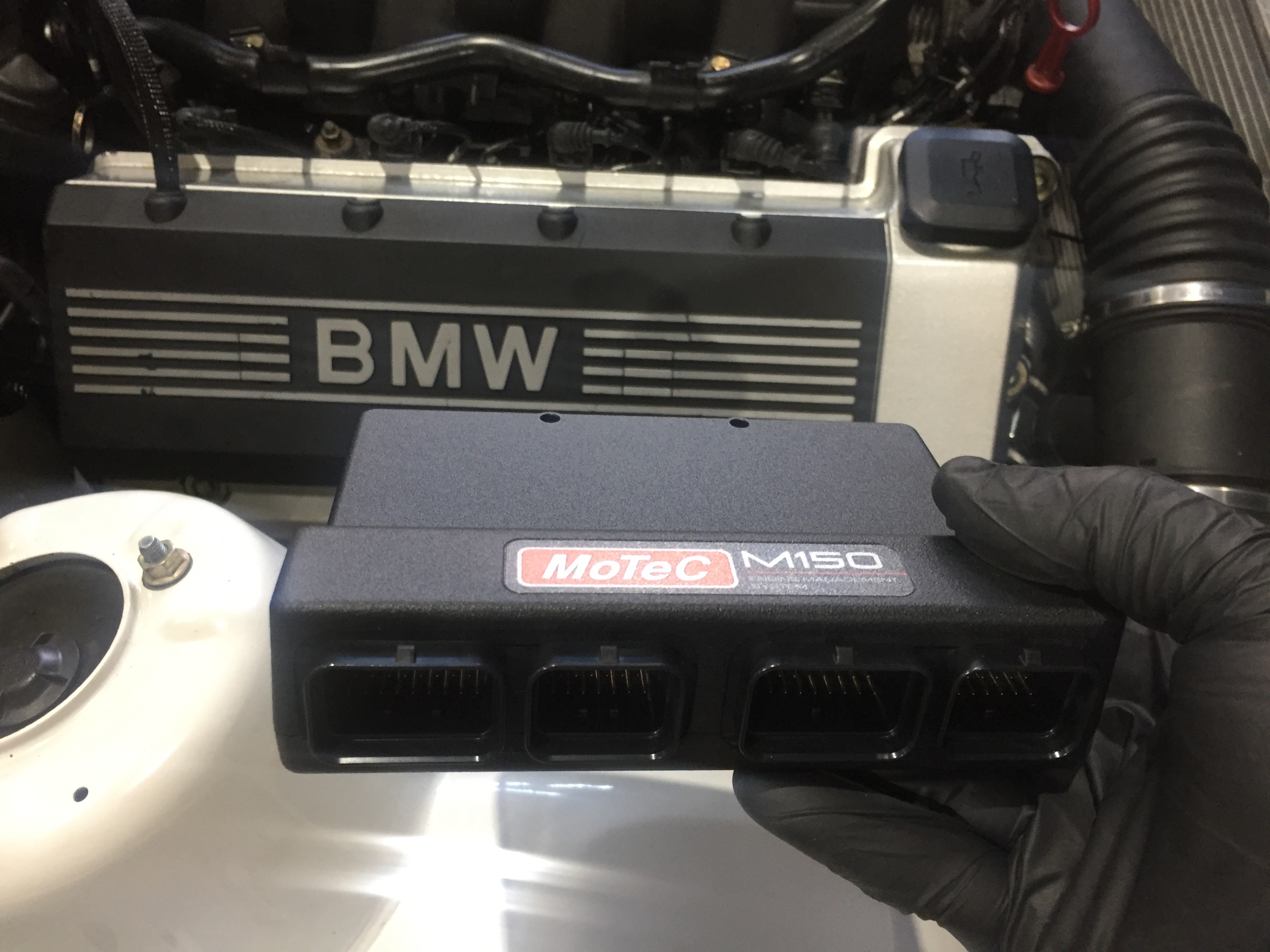
Please check my other article about mean piston speeds, and volumetric efficiency here. Keep the mean piston speed below 21m/s, and you’ll have sufficient longevity for your build. For performance oriented build, and the extended power curve you’ll need hotter cams. With stock cams you can get very nice low-to-mid range torque, but not the extended power range. With right cams your effective shifting point can be on 7500rpm+ territory, while still having massive amounts of low-to-mid range punch and engine responsiveness. The best option is to go with hollow, gundrilled Cat Cams. Cat Cams can provide several options for M60 cylinder heads, including cams with customer specifications. For starters, Cat Cams sports are viable option if you still want to use stock ECU. Hot street or race cams with more aggressive overlap will provide you with extended power range, when combined with well built exhaust headers. More aggressive cams and lightweight components do require aftermarket ECU such as Motec M150 or similar in order to keep idle, and in case you want to utilize all 4 knock sensors.
Gundrilled, hollow Catcams in M60B44 hot street engine. These are 3,6kg lighter than stock cams.
Selecting right headers for your build
There is at least two aftermarket manufacturers building headers for M6x engines. You can also built them yourself, or let a workshop to do the magic. Please note, there is no need to go with bigger than 42 mm primaries on any configuration with less than 600hp. Optimal primary lengths are based on wave harmonics for desired operating range. Changes in your engine configuration will change the optimal primary length. Hot street build optimized for 4000-6500rpm range can be used either with long 730-790m primaries, 440-500mm mids, or 310-370mm shorties. Suitable collector size can vary from 2.25″ to 2.5″ depending on an intended use, and configuration. For street use my recommendation is 2.25″ collector. Optimal exhaust for M60B44 is dual 2.5″ with X-pipe, and free flowing mufflers. Optimal placement for X-pipe is about one meter from the end of primaries. Recommended, high quality manufacturer for custom spec exhausts is Martelius.
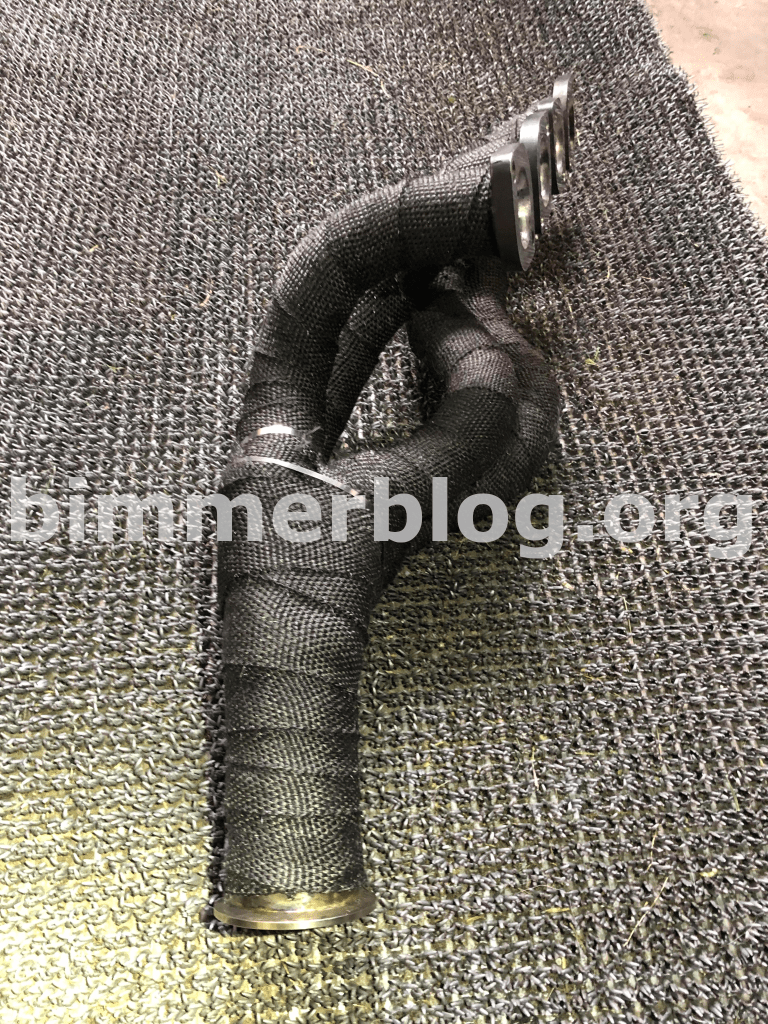
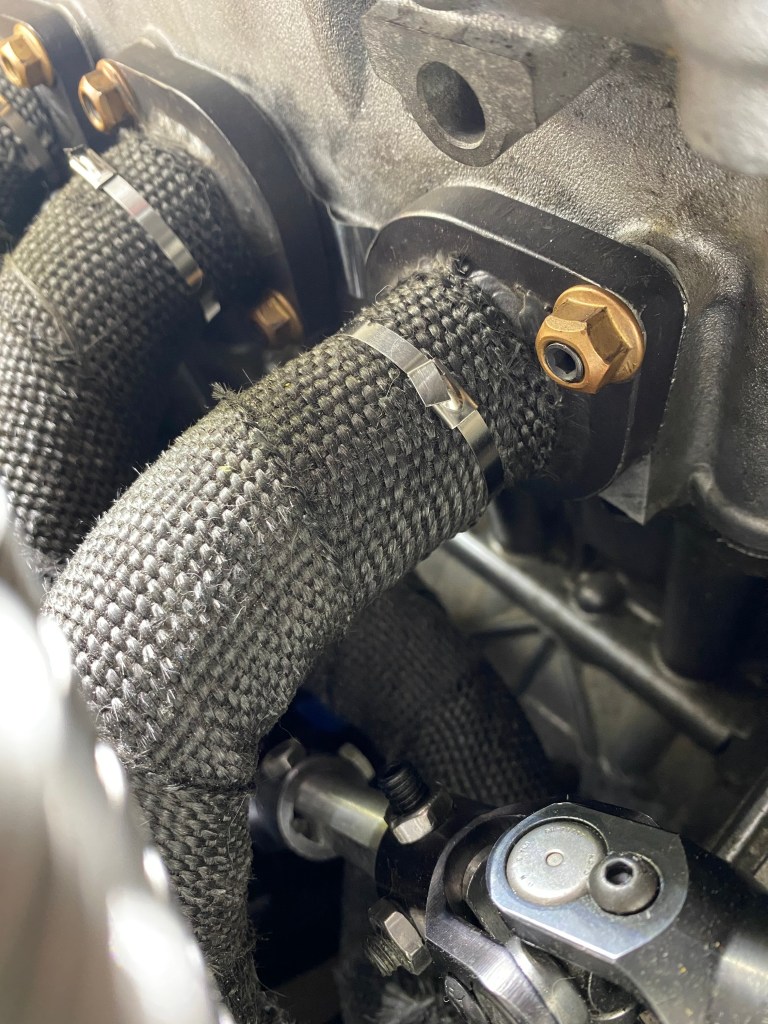
Mid length 41mm (1 5/8″) primaries with ported flanges. Note the follow-through for steering shaft.
Be advised with steering shafts
Exhaust headers for E30 V8 swap are tight fit thanks to bulky steering shaft. DO NOT weld, or shave off any material from any steering shaft configuration. Condor Speed Shop is providing bolt on steering shaft conversion kit for extra clearance. With stainless steel shaft you can get rid of the rubber coupler too (Rubber and heat = not good idea). The heat will destroy the stock rubber coupler, and likely will weaken other plastics as well – go with the full steel on this. The result is sharper steering response, and much safer build. I cannot emphasize this enough – Do not cut the corners on this.
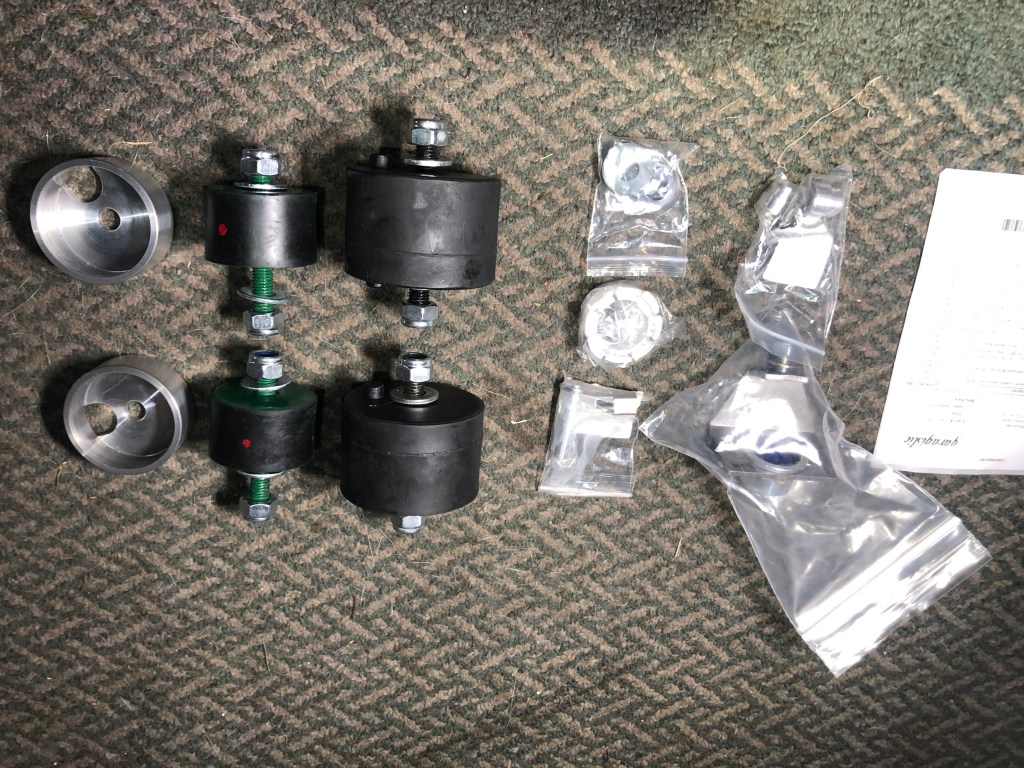
V8 engines are ruthless on first gear. 500nm of naturally aspirated torque on first gear translates to 6630nm of torque at rear wheel. (500nm x 4,21 tranny x 3,15 diff). No need to wait torque delivery on 3rd gear like turbocharged engines, instead you are full on from starting line. Combine this with 50% limited slip differential and semi slicks, and you can have some serious issues to keep engine, transmission, and rear differential at the bay. And I’m deadly serious about this. I broke universal light truck engine mounts with my first build. If you are looking for engine mounts, and what ever brackets please consult the dudes on Garagistics. The company provided me with correct bushings for transmission linkage, even I tumbled on describing the right combination. Likely one of the best customer service experiences I have ever had.
Transmission mounts with enforcer cups from Garagistics, and polyurethane shifter bushing kits for a tight feeling shifter. Please note there is both rounded and oval bushings for carriers.
About dual mount differential covers
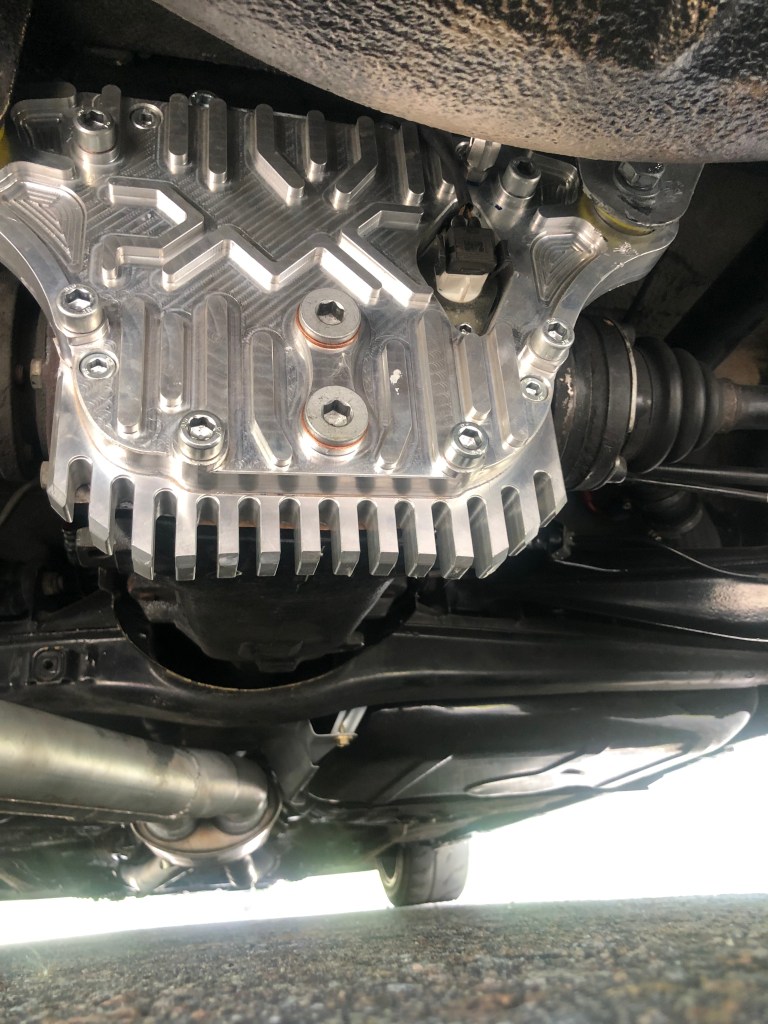
Stock diff covers on E30 are with single mount ear. Since driveline is under elevated stress its highly recommended to install heavy duty rear differential cover with dual mounts. There is several options out there, and while non of them I have seen are optimal (Tip me if you see any decent ones), its better to have a setup that can withstand the torque on first gear. You can either go with a stock E36 rear cover, or have one of the aftermarket ones.
Most aftermarket diff covers are not hemisphered, but nevertheless can offer more rigid assembly due to billet design. in the picture: PMC diff cover with improved breathing design.
Aim for serious gains with volumetric Efficiency (VE) of over 130%
The cylinder heads are CNC milled from the factory, and provided in 4-valve configuration with 35mm intake, and 30,5mm exhaust valves. Add this with professional porting services, and the cylinder heads can flow up to 300cfm @28″. This means theoretical hp of 600hp. Tick all the boxes mentioned on this blogsite, and your 4,4 litres V8 stage 3 configuration can charge air with Volumetric Efficiency (VE) of over 130%. That is state-of-the-art for an internal combustion engine.
Ported M60B40 cylinder heads with 35mm intake, and 30,5mm exhaust valves can flow closer to 300 cfm@28″
The base recipe for M60B44 consists of:
M62B44 bottom end,
M60B40 cylinder heads,
M60B40 robust timing assembly with duplex chain,
M60B40 wiring harness, sensors and ECU.
Benefits of building M60B44 engine:
Increased ~ 10,9:1 compression ratio,
By shaving 1mm from cylinder heads you can increase compression to ~ 12,2:1
Almost ideal stroke-to-bore ratio. In comparison, Ferrari 458 engine with 4,5 litres capacity has 94mm x 81mm (Bore x Stroke) whereas M62B44 engine is 92mm x 82,7mm,
4,6 litres and bigger M6x bottom ends increase stroke, which leads into increased piston speed, and compromised high rpm performance,
Wide selection of high quality M60 engine cams from Cat Cams,
Cylinder heads are CNC machined,
32 valve cylinder heads can flow 600hp,
Ported cylinder heads can provide excellent low lift flow,
Robust duplex timing chain that can take the beating,
Stiffer dual spring valve train. To gain real benefits from the M60 springs, you must assemble lighter lifters, see my other article here,
660-960 grams of weight saving with aforementioned lifters, allowing the top end to sustain revs up to 8400 rpm,
Durable Alusil block,
Lighter forged crankshaft, thanks to revised design with the central hollow cavity,
Oil spray nozzles for pistons,
Gaining the benefits of using M62B44’s MLS-type cylinder head gasket.
As you can see above, M60B44 combination gives you great prerequisites for building race, or hot street engine.
Building tips for M60B44 engine:
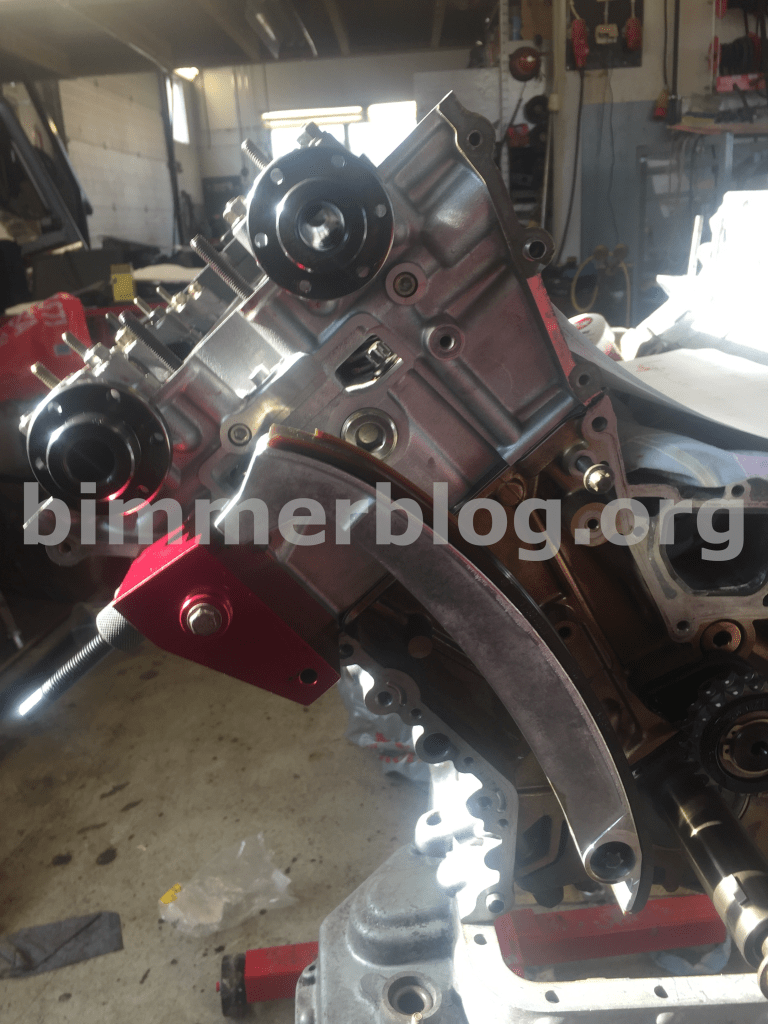
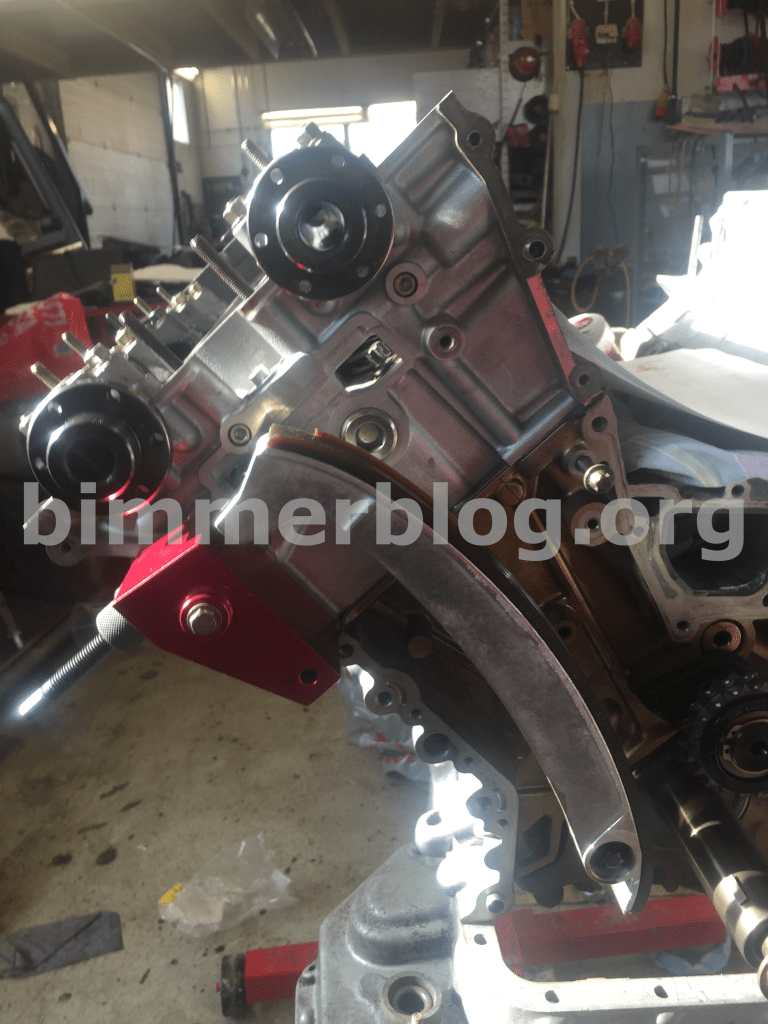
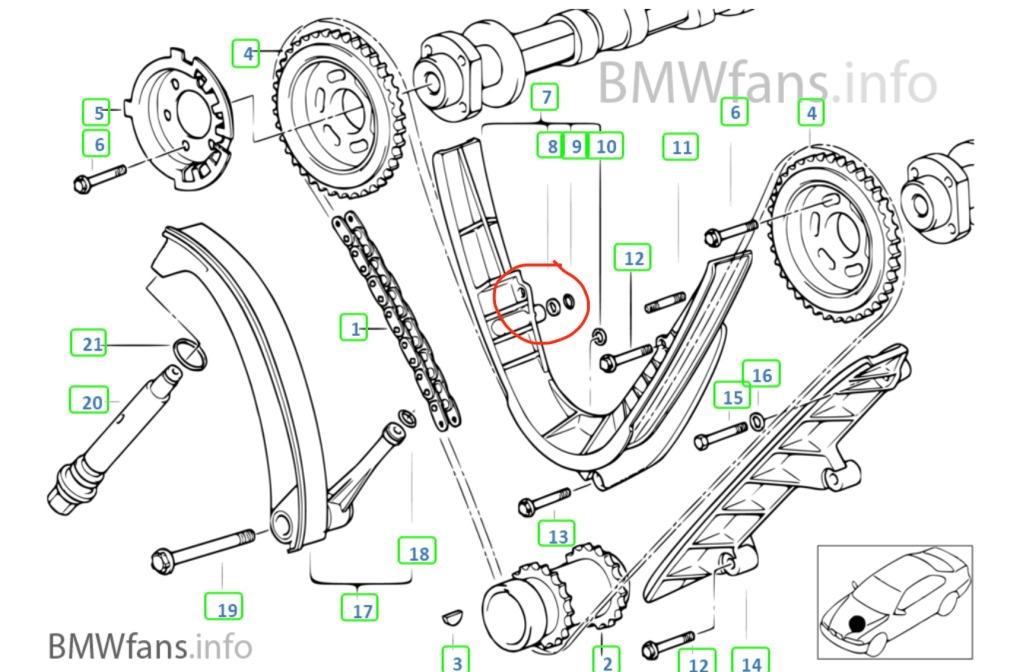
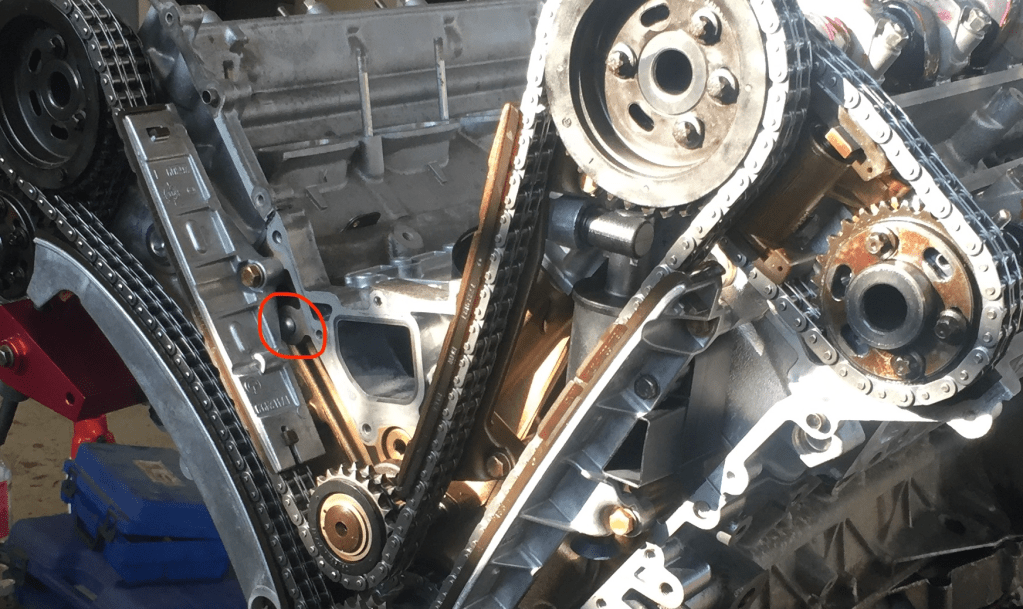
Remember to block the obsolete oil channel for M62 cam tensioner (See the pic below),
Stock ECU can handle sport cams with couple degrees of overlap (1mm-to-1mm). If you go with more aggressive cams such as 8 or more degrees of overlap (1mm-to-1mm) you’ll need an aftermarket ECU,
Reduced inertia can also cause your engine to stall on traffic lights, even with mid priced aftermarket ECUs,
With all above tips utilized, your engine is capable of producing amazing torque numbers, all the way up to 113-115 nm per litre.
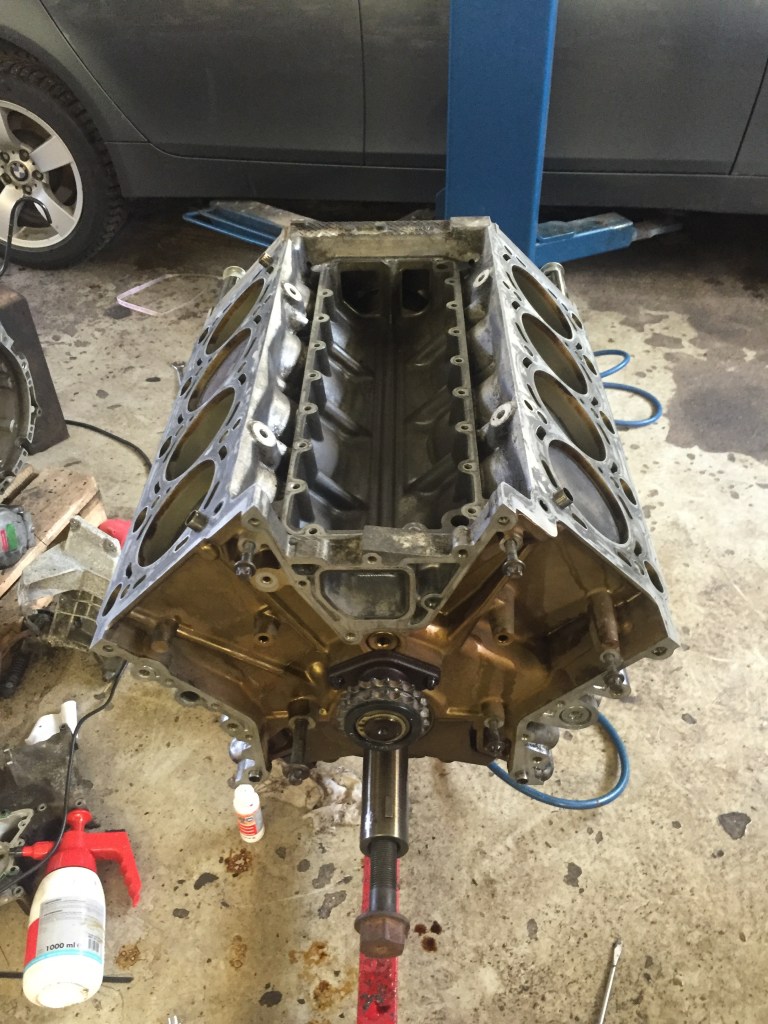
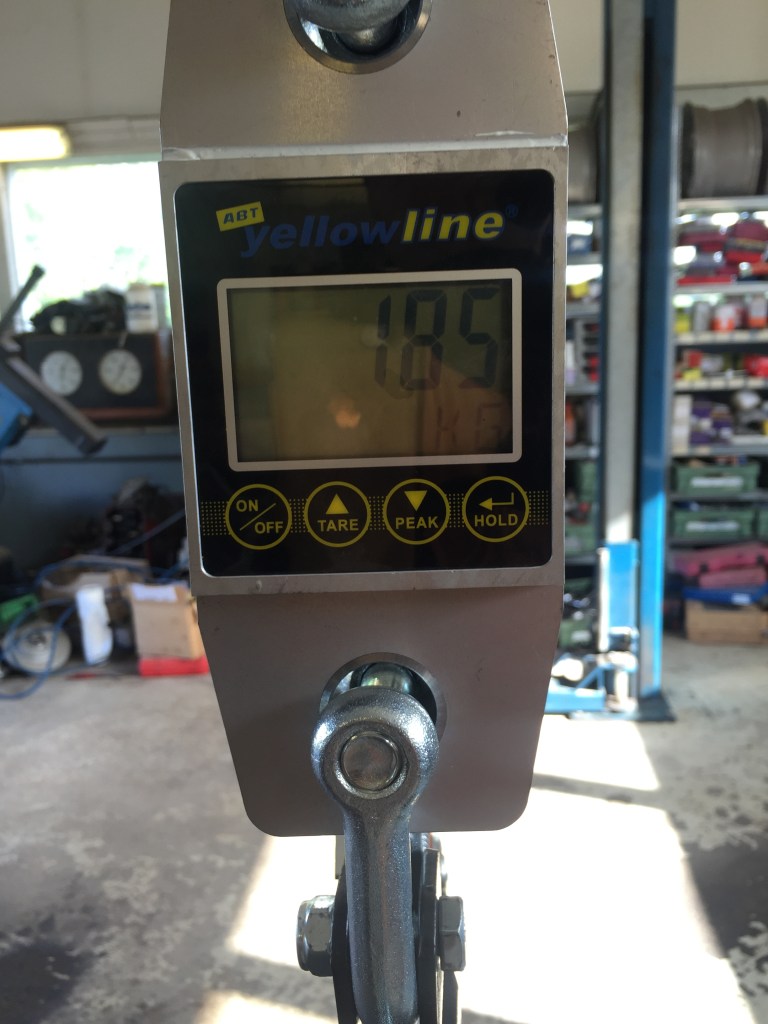
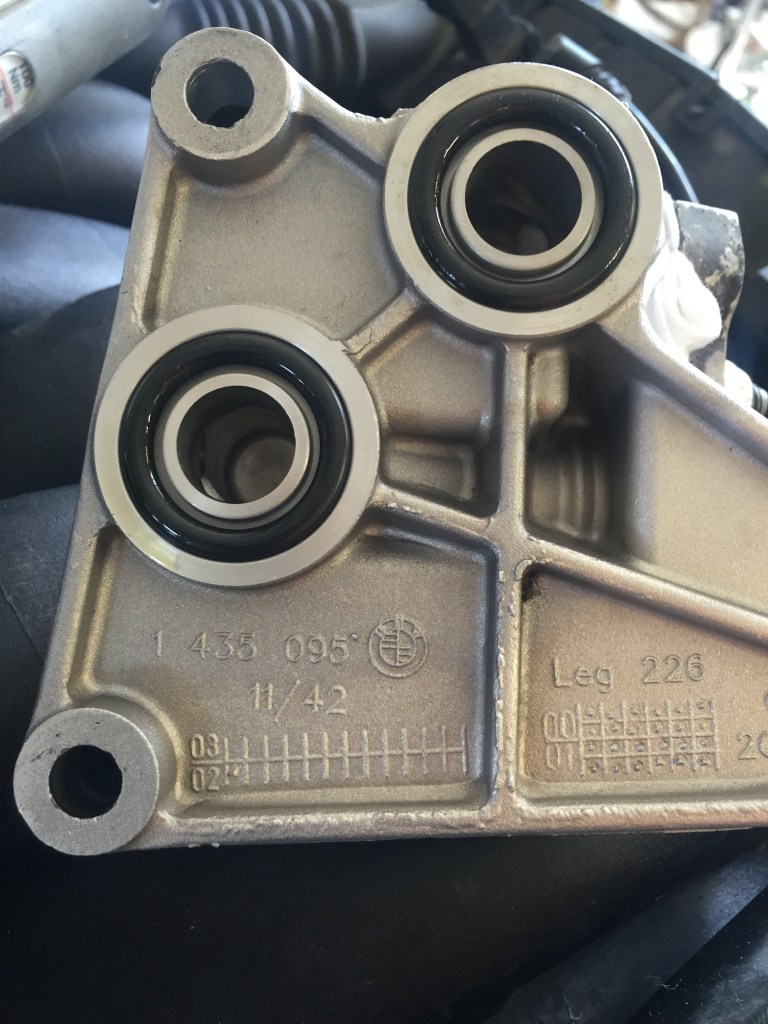
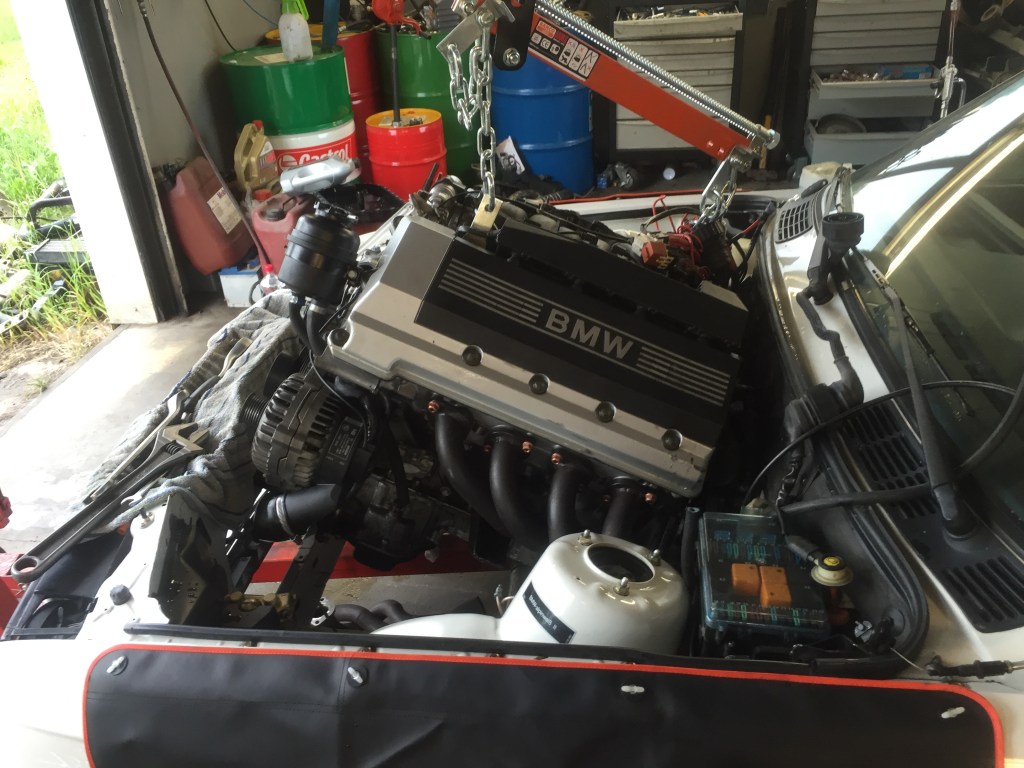
This is where it all begins, the building of custom M60B44 engine.M60B44 dry engine weight without starter motor and generator. Not that heavy!X5 oil assembly leg Nr. 1142 1 435 096 to use with E30 M6x swaps.
The obsolete M62 assembly with deflection rail (Nr. 7), and the location of the oil channel (Nr. 8 and 9).
M60B44 hybrid engine with robust duplex timing chain, and blocked oil channel.
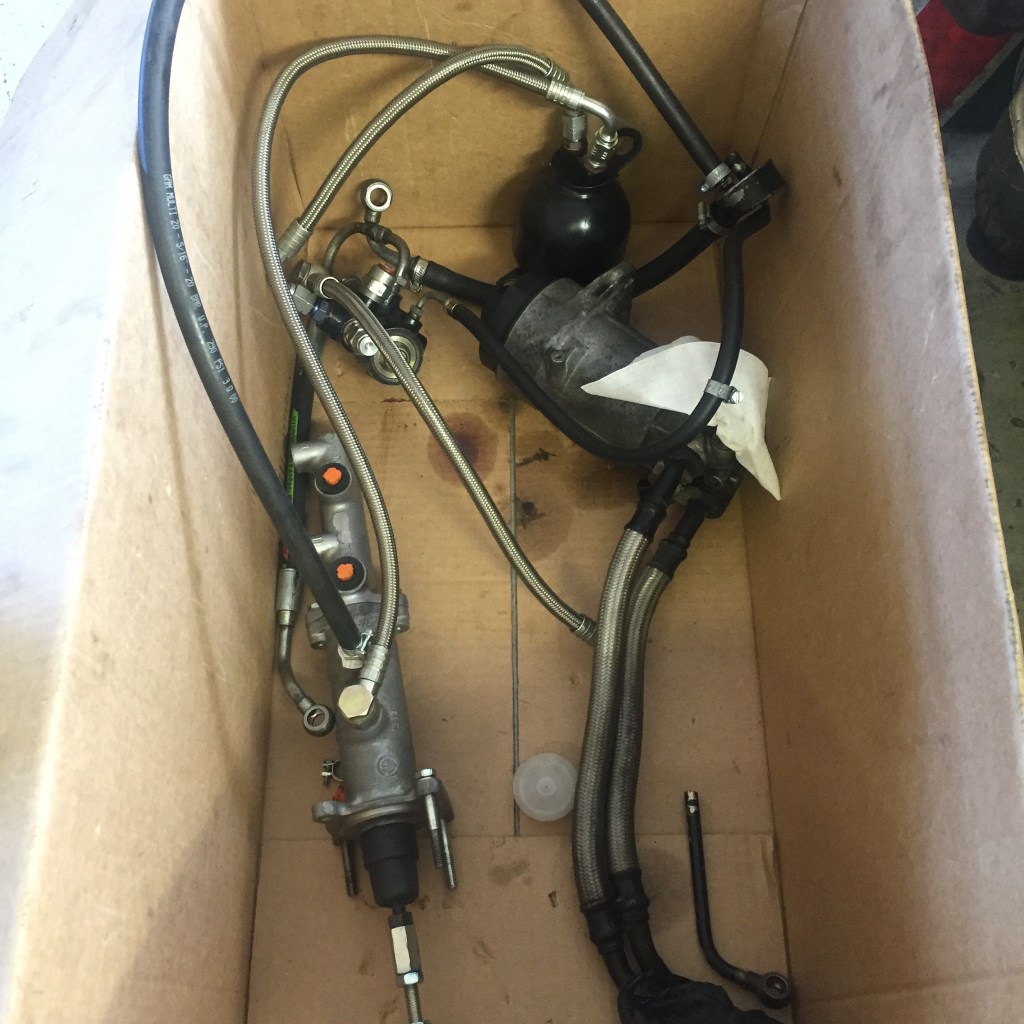
Hydraulic brake booster and brake master cylinder from BMW 850i (E31) for high quality brake assembly.M60B44 stage 3 engine is built to take some serious beating up to 8400 rpm!
More information about performance upgrades can be found on my other articles:
Search no more. You found the information in regard to performance upgrade for BMW M60 hydraulic lifters. They are also known as flat tappets, hydraulic tappets or just simply – lifters – they are all meaning the same – a hydraulic element which is in between your engine’s camshaft and valve, adjusting the valve clearance by utilizing hydraulic pressure. They are called flat tappets for a reason: the top of the lifter is flat, and while its moving up and down in relation to an engine speed, it is also rotating around its axis. Inadequate manufacturing quality (When using cheap Chinese parts) and the requirement for flat tappet rotation can create major challenges during a first startup, if lifter(s) will fail to rotate. This can lead to permanent cylinder head and camshaft damage.
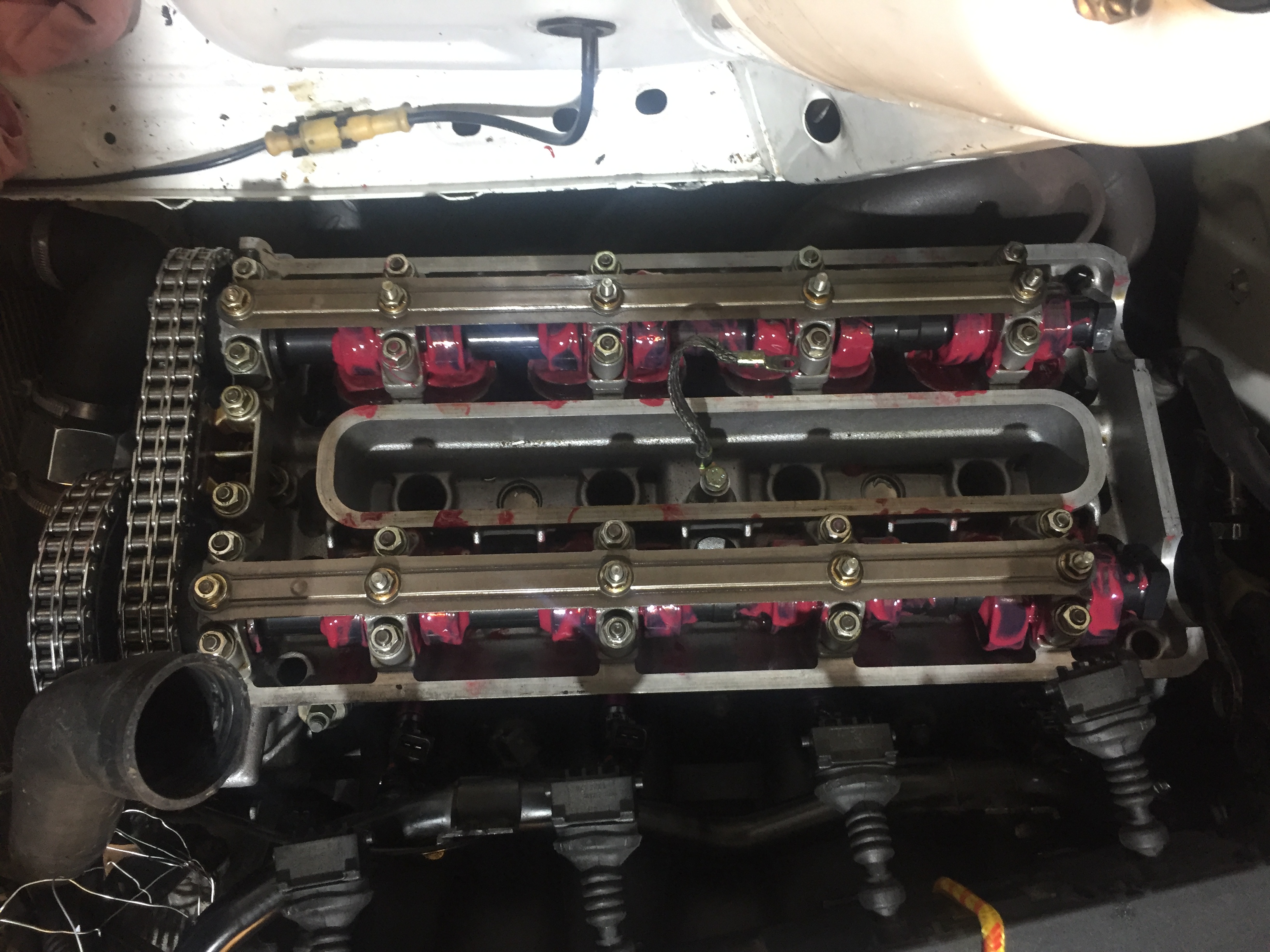
Use appropriate cam lube during the assembly. Immediately after the startup, keep the revs continuously above the 3000 pm territory. This will ensure that new flat tappets can start to rotate along its axis. Do not let your engine to idle for the first 20 minutes! Higher rpm during a break-in period will provide both A) higher oil pressure for lifters and B) higher rotating force through camshafts
Engine comparison: M60 vs. M62 engine
M60 engine design is from early 1990’s. This means the engine was utilizing 35mm valve lifters used in both M50 and M42 engines. On M62, the factory wanted to reduce:
A) Rotating masses,
B) Increase the total efficiency of the engine,
C) Make the engine more quiet and sophisticated,
D) Reduce manufacturing costs
Thus the reason, why the factory ended up upgrading flat tappets on M62 to smaller diameter of 33mm. From the perspective of performance tuning, some of M62 modifications are not welcomed in terms of top rpm reliability, like the infamous change from “stronger-than-a-tank” duplex timing chain to a fragile single version. OK, let’s get back to lifters.
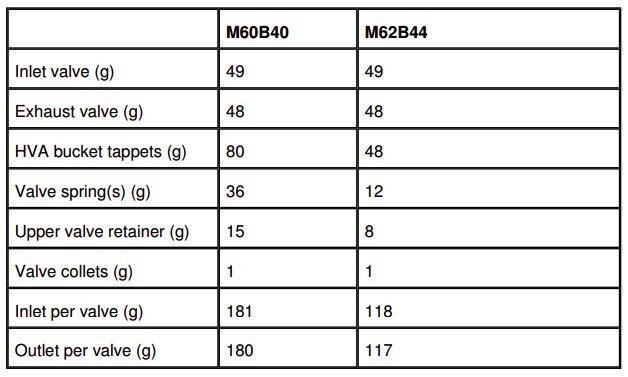
According to bmwfans.info, M60 hydraulic valve lifters weigh 78 grams,
While M62 flat tappets weigh only 52 grams, according the same source.
Please note: that is over 26 grams weigh reduction per valve-spring package! When you multiply that by 32, you can see, how the factory managed to save 832 grams from the flat tappets only!
Comparison chart of M60 vs M62 valve trains. Notice the weight of factory M60 flat tappets.
Benefits of utilizing the lighter valve train on M60 engine
Because heavier M60 flat tappets require more stiffer valve springs, M60 engines have dual valve springs, while M62 has single ones. In terms of performance tuning, this can be either disadvantage, or advantage. The upside is: if you can find a way to reduce the overall weight of moving masses from M60 valve-spring package – without affecting the spring rates, you can get your valve train to sustain higher rpm range. And this is especially advantageous if you are after naturally aspirated performance tuning.
Our calculations show, that by reducing 20 grams from the valve-spring package – while utilizing both M60 stock valve springs – your M60 engine can sustain revs up to 8400 rpm. Ladies and gentlemen: it is on S65 territory! Please be advised: The maximum sustained rpm is mostly dependant on cam profile, namely aggressiveness of cam lobe (cam duration, lift), and to some degree on intake system efficiency.
Do I have to change my cylinder heads to M62?
No. You do not have to change your cylinder heads to M62, if you own M60 engine. Actually, the reality is the other way around: you may be interested in creating so called hybrid or frankenmotor with M62 bottom end matched to M60 cylinderheads – this will provide you prerequisites (Prerequisites only, thus most frankenmotor projects I have seen have failed to utilize this untapped potential) to build a high compression performance engine.
If you already have M62 engine, the advantage of hybrid motor is the upgrade to more robust duplex timing chain. The end result is pretty neat way to combine the best features from both engine families. Only downside is the heavier M60 valve lifters.
How to fix the issue of heavy flat tappets on M60 engine?
This modification is applicable if you are:
A) After performance upgrades,
B) Not worried about engine sophistication nor quietness,
C) Chasing for reliability on 7000rpm + category
You may have heard stories about fitting VW lifters to M42 318is engine, but you are lacking the proof of concept, right? Afterall, both M42 and M60 are using the same flat tappets.
Here is the proof of concept: I have successfully drove the M60 engine with VW tappets over 16 000 kilometers (Updated on 7/2024). Yes, they are not the most quiet, but they can take up the beating. My rev limiter was initially set to 7800 rpm. Afterwards, it was lowered to 7600 rpm. That is essentially the effective shift point.
VW hydraulic lifters to BMW M60 engine
The VW valve lifters in question are manufactured by Febi Bilsein. They can be any brand you prefer. I ordered mine from autodoc.de – not the best service, but affordable prices.
The part number is 07060,
outer diameter 35 mm
Height: 26mm.
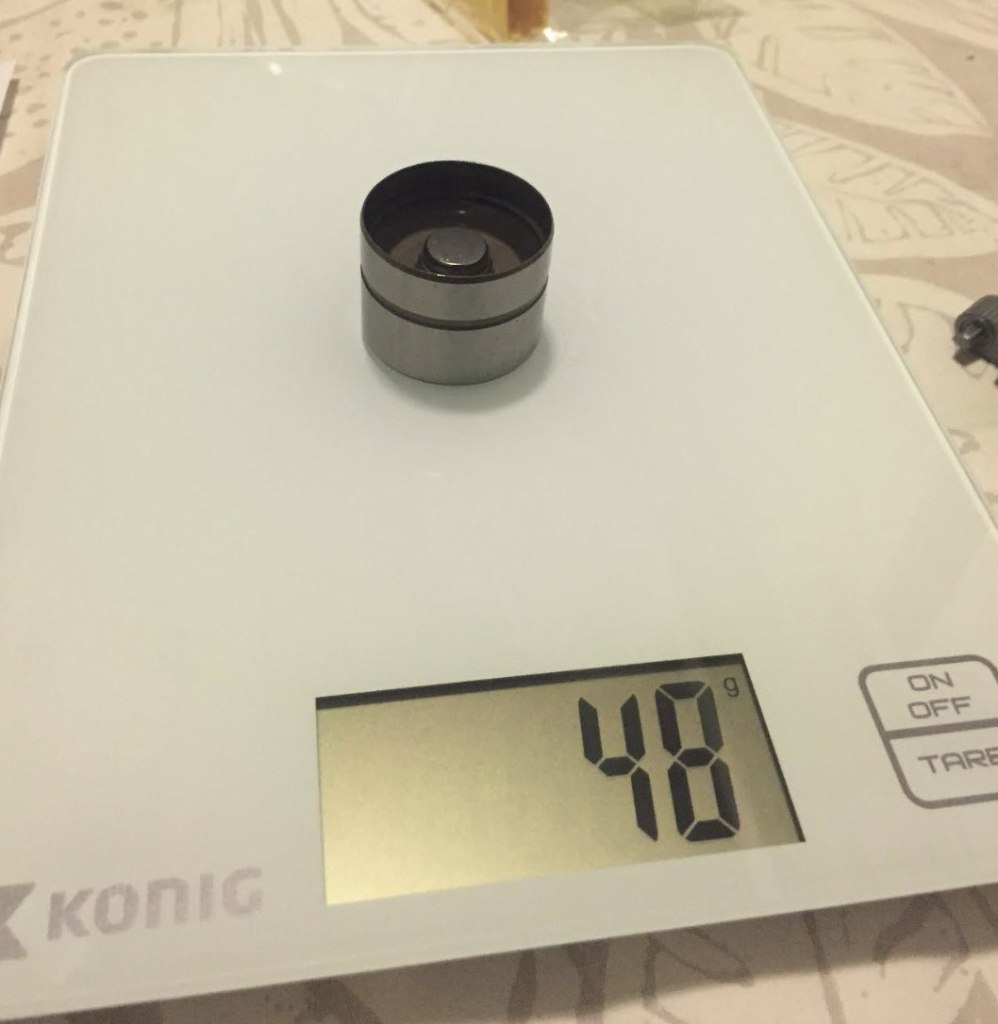
Weight: 56 grams
Happy E30V8 revving!
Some 35mm lifters can be as light as 48 grams, putting them on par with stock M62 33mm flat tappets.
There is more information about performance upgrades on my other articles:
A bit provocative question – and far too broad – in order to give you any simple answers. Basically, the most suitable ECU for your build is the one that suits the most for your preferences, which may vary a lot. Consider an ECU as an investment, where putting more money will get you both more features and quality in return. It is a return of investment. If you will break your engine due to lack of experience towards ECUs, their capability for warning limits and limp modes – it doesn’t matter – if you saved one or two thousand by selecting a cheap ECU in the first place.
The rule of thumb: If you are first timer, you will almost certainly buy a low quality ECU, regardless of all info provided on this blog article. If you are more experienced tuner, you most certainly recognize the importance of knock sensors, data logging, warning limits, extra connectivity and support, which more expensive ECUs will provide for you.
Let’s start with a common aftermarket ECU features. At first hand, these may seem minor issues on your list, but when time goes by, they will grow ever more important:
Checklist when buying an aftermarket ECU:
Configurability of basic parameters (e.g. injector data)
Ability to control IDLE QUALITY with hotter cams
Ease of use and connectivity (e.g. stability, speed, future support)
Longevity of both firmware and program support
Quality and number of support in your country
Number of extra inputs and outputs
Number of knock sensors
VE table configuration (a quite basic nowadays, thankfully)
CAN support
Full sequential support
Warning limits
High quality, wide band closed loop (For handling exceptions and monitoring)
Ability to control up to x number of variable cams for your build
Quality of data logging features: storing, reading and analyzing of data
One good example – actually a bad one – is Miller Warchip. They started with promising livechip feature for 1990’s bimmers, but when years passed on, company struggled to provide necessary support, leading to bad customer experience. If you still want to use Warchip, you are only good with legacy OS with legacy Java on Windows XP. ECU’s support for future upgrades is critical, thus you may have your build for decades. A financially stable company can provide you the best support for software upgrades in future.
How about tuning OEM ECUs? They can be divided into four main categories:
Reprogrammable ECUs
ECUs with add on ‘piggybacks’
ECUs with livechip
ECUs with switchable chip
The newer your OEM ECU, the easier it is to tune. What comes to M6x engines – they are type 2-4 ECUs. Most of us do prefer M60 OBD1 wiring harness and ECU, due to their simplicity for E30 swap. Thus ECU standards were under heavy development in 1990’s, you can face strange oddities in M6x ECU, like frequent EWS updates, or a sudden transition from OBD1 to OBD2. Generally speaking, ’99 model year is the milestone, when M6x engines were fully OBD2 compatible through KCAN interface. Luckily though, most M6x versions support live data logging through program called testo.exe, which I have explained here.
There is some evidence for BOSCH DME 3.3 ECUs having issues on both BMW M60 and Audi S6 engines on ’94 model year ECUs. Some of these, even with fully functioning live or custom chips can face strange oddities, if your build meets one or more criteria:
Your engine’s power range is extended to 7000-8000 and/or:
You are using bigger injectors, and/or:
Your stock MAF is not flowing enough, and/or:
You are using hotter cams -> a stock ECU cannot maintain idle -> an engine is stalling at traffic lights
Thus OEM M6x ECUs are somewhat limited for serious builds, it is advisable to turn your eyes on aftermarket ECUs. A bit surprisingly, OEM ECU can handle supercharging better, than building a hot street NA engine.
The problem most first timers lack to understand when selecting an ECU:
ECU’s ability to control idle quality with hotter cams
ECUS’s ability in normal driving conditions: cold start, cruise speed, stopping at traffic lights without stalling
ECU’s ability to prevent a total disaster of your build: Setting up warning limits and limp modes
A list of warning limits any engine builder shall employ in order to trigger a limp mode:
Continuous Oil pressure (OP) and temperature (OT) monitoring
Continuous Fuel pressure (FP) monitoring
Engine coolant temperature (CT) monitoring
In addition, following features must be monitored too:
Knock detection for ignition compensation
Warning limits for boost control (through MAC-valve)
Remember: the easiest part of your engine tune is to setup Wide Open Throttle (WOT) area of the map. It is the graph with nice looking power curve of your build. In reality, the most time consuming part is setting up an idle, cold start and driving quality for cruising conditions. And this is what you pay for.
Think about buying an ECU as an investment. By purchasing high quality parts, you can save big bucks in the long run, possibly avoiding a total disaster of your build.
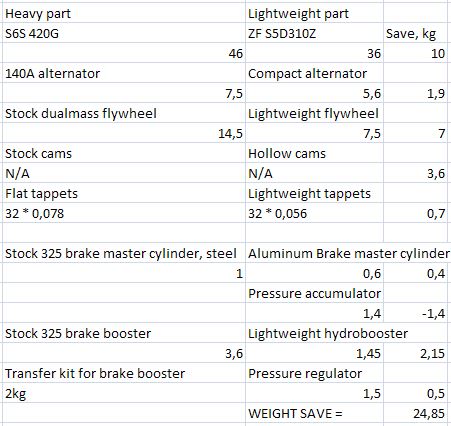
Did you know you can save up to 25 kilograms of an engine weight by selecting the lightweight components for your M60/62 build? This reduction can have a crucial effect for your E30 handling. Lighter, the better. Don’t be fooled by excessive weight of modern cars. They still follow the same laws of physics, no matter what marketing department puts us to think. Simply put, all modern BMW’s are too heavy for motorsport. They are not build for motorsport, as was E30 M3 in 1980s. And that is exactly the reason why we are tuning E30s. They are lightweight and offer you a unique driving experience – as if you are a part of a machine – a driving feel any reasonably priced modern car cannot offer for you. There is some lightweight hot hatches, but due to their FWD nature, they are excluded from the equation. Only on the day, when Formula One will switch to FWD, I can admit I was wrong with the amazing driveability, fun and excitiveness of FWDs…
So the weight is you worst enemy, thus your engine must be as light as possible, while providing an instant throttle response and a wide power range. Not so easy task, but doable for full aluminum V8 engine.
Please find below the table about the selection of the lightweight components, and their heavier counterparts:
Selection of lightweight components
Note 1: I excluded lightweight headers from the table, thus stock headers and lightweight custom headers are approx. the same weight, due to 4-1 nature of lightweight headers vs. stock headers with two primary pipes.
Note 2: Example above uses the lightweight hydrobooster from 7 and 8 series instead of a stock brake booster. This will have a double effect for your build:
No extra weight is moved forward
Hydrobooster is lighter than stock brake booster with a transfer kit
Note 3: Please note you can have further weight savings by:
Air condition delete
Catalytic converter delete (regulations will vary)
Keep windshield washer reservoir empty
Change bonnet to carbon fiber (-16kg)
With smart actions for weight saving, you can improve your V8 build’s handling substantially. Of course, there is more aggressive weight distribution tactics, like moving engine backwards, but I consider these too excessive for a street car. You can make your V8 behave like a dream by using the tips mentioned on this blog site. So how fast E30 V8 can be while cornering, if done right, you may ask? Probably faster, than your have the guts to put the pedal to the medal.
Lately, there has been a trend among experienced tuners to turn their eyes back to naturally aspirated engines, thanks to their ever challenging and unforgiving nature. Their is just something fascinating in a high revving naturally aspirated engine, especially in a V8.
Let’s admit: If you are interested in maximizing horsepower: buy a turbocharger. It is the easiest way to add power to your engine. But if you are like me, you are not interested in max hp. You may be allergic to turbolag, and interested in faster-than-light throttle response, in order to maximize the traction and driveability. Mate, this is the right blog for you. It is not about maximum hoos pauwo. It is about maximizing your fun, while you are driving along 101 on a west coast, or where ever you are enjoying your E30. In these situations, 300 to 400 engine horsepower and steady 400-500 nm of engine torque is much better than a galaxy exploding power curve. On rear wheels with 4th gear it means approx. 1500-1900nm of torque, if you are using a 5 speed ZF S5D310 and 3.15:1 ratio differential. You can consider 2000nm of rear wheel torque the upper safe limit for twisty (and both dry and clean) roads with 225 semi slicks. Just put the fourth gear on, and start enjoying.
The general idea is, that you may seek for more speed, but you may not be able to put any extra torque to rear wheels, or otherwise you may loose traction. This seems to be pretty tricky for folks to understand. It is the torque on rear tires that makes your driving either fun, or scary and difficult. And that’s why an electric car can be very fast on a track: they are providing steady torque, without any interruptions whatsoever. It means they are easy and logical to drive up to the limit. It is the same reason, why modern BMW diesels have even four turbochargers.
If you are living in the U.S, its pretty straightforward to install a LS engine into your E30, and start enjoying. While in Europe, M6x is popular swap due to a high number of potential engine donors available. And that makes it interesting tuning project for E30. With a basic M6x swap, you can get up to 286 hp for your E30. So your motives to build an engine swap may vary where you live at. M6x is very capable engine, and will response into a tune like any other engine.
Why not M5x then? the V8 has both more displacement and valve area than its little sister – making it the better choice for a NA build. There is no replacement for displacement – the V8 is basically a two four pot 16-valve 318is engines in the same. But if you are going to turbocharge your engine, the six pot can be better starting point, thus its much cheaper to rebuild with forced internals. Turbocharging M6x is more expensive, requires high demand from powertrain, and all these will add tens of kilograms of unnecessary weight on a front axle.
If you are about to keep your engine NA – go for V8 – and keep it as light as possible, thus it is one of the keys for good handling. Even among NA M6x builds, you can save up to 27 kilograms from a front axle, only by making smart decisions for your build. But V8 is still so heavy, you may say. Well, it can be either a true or false. A well built M6x swap is equal in weight to a stock E30 325i. I know this, because I’m a guy with two engineering degrees, and being taught to measure, before start making any hypothesis. In full driving condition, including all fluids and 3/4 of gasoline E30 weights 1180kg with M60 engine. It is in the par with the stock E30 325i. It is a bit of a surprise, but M6x cylinder block is lighter, weighing only 28 kilograms, than a good old four pot M10 block. The name of the game is aluminum.
A good reminder if you are first-timer in performance tuning, please repeat with me: A naturally aspirated engine is as strong as its weakest link. So tuning NA engine is like drinking a fine vine: there are no shortcuts in the making. Repeat with me: there is no single shortcut. Not only horsepower figures, but also the quality of your build through lightweight parts has to be taken into account. Many times the information from public bimmer forums is limited what comes to NA M6x performance tuning. You must face it: Tuning a naturally aspirated engine is an expensive task. If you have extra penny to spend for performance tuning, then go for it. If you don’t have, it may be advisable to stick with a stock engine.
There are excellent articles out there about faulty Positive Crankcase Ventilation (PCV) systems, like the one on Timm’s BMW E38 Repairs and information page. PCV or Crankcase Ventilation System (CCV) is basically the same valve with a different name, only acronyms may vary.
This article is from the perspective of performance tuning. If you are about to install hotter cams, raise compression or rev limiter, it is important to understand the design flaw in a stock M60 PCV system. The described mods typically increase engine performance, but also put more stress – and blowby – through the engine. These blow-by gases are the reason, why there is a system called Positive Crankcase Ventilation in the first place. Thus, when you increase stress to your engine by increasing both compression and rpm, you will increase the amount of leaking gases to a crankcase. This will put increased demand to PCV system to do its job.
Unfortunately, the stock M60 CCV design is faulty from the factory. It does not matter if you replace the item with a new one – it is not up to its task, more less when you are doing any performance upgrades.
The main havoc for the stock PCV system is the design: all gases and residue will accumulate in the front of cylinder 8 runner. When there is enough sludge, and you accelerate hard at the same time, the cylinder in question will gulp all the residue into the combustion chamber. The result is pretty obvious: the Pope like white smoke is a testimony of compromised combustion chamber process, with excess oil.
M60 intake cover with Positive Crankcase Valve, PCV. Sludge will build up next to a cylinder 8 runner, and eventually find its way to the cylinder like a big gulp. Hence the occasional white smoke, when accelerating hard to a highway.
Installing an oil catch tank
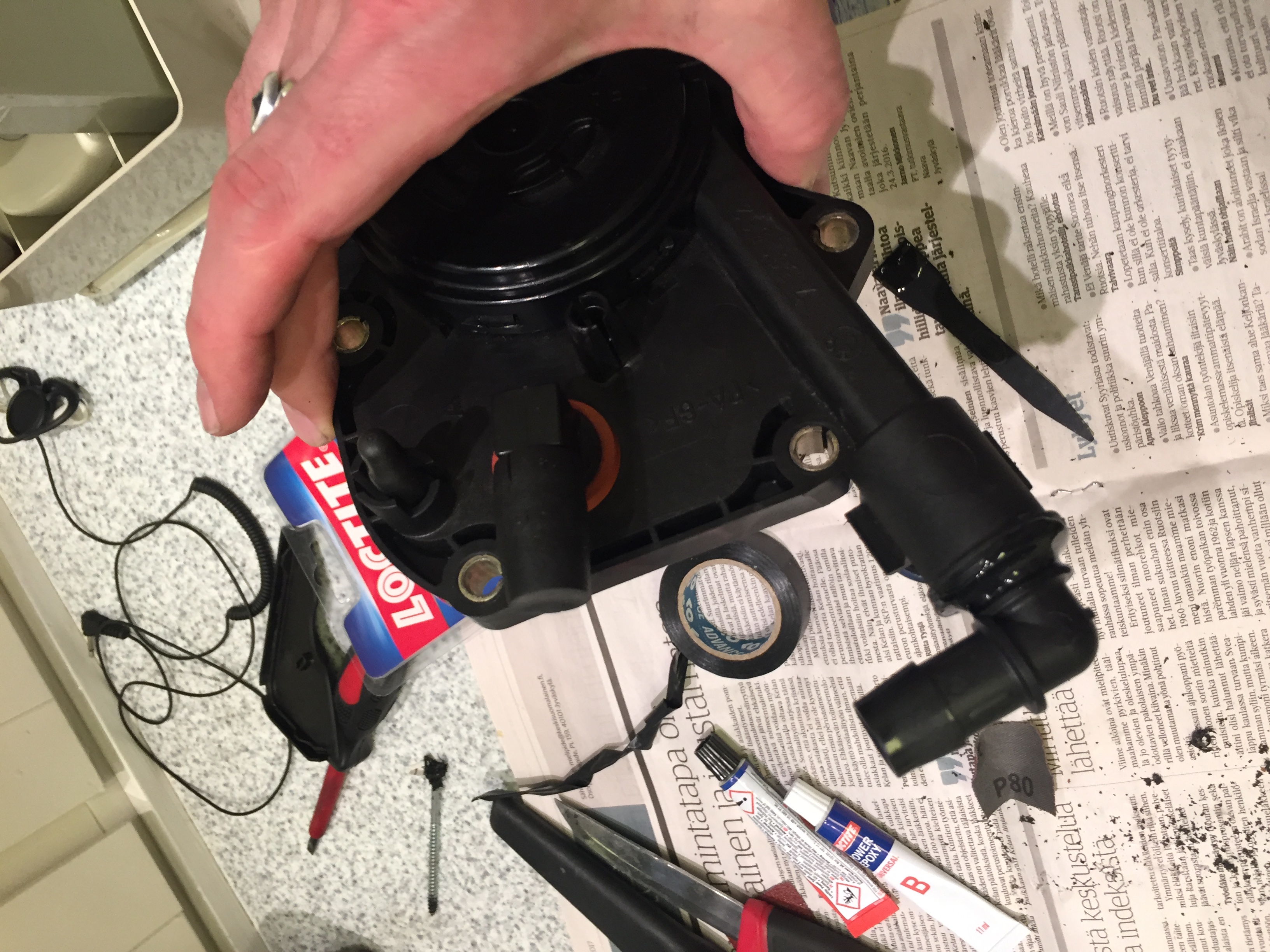
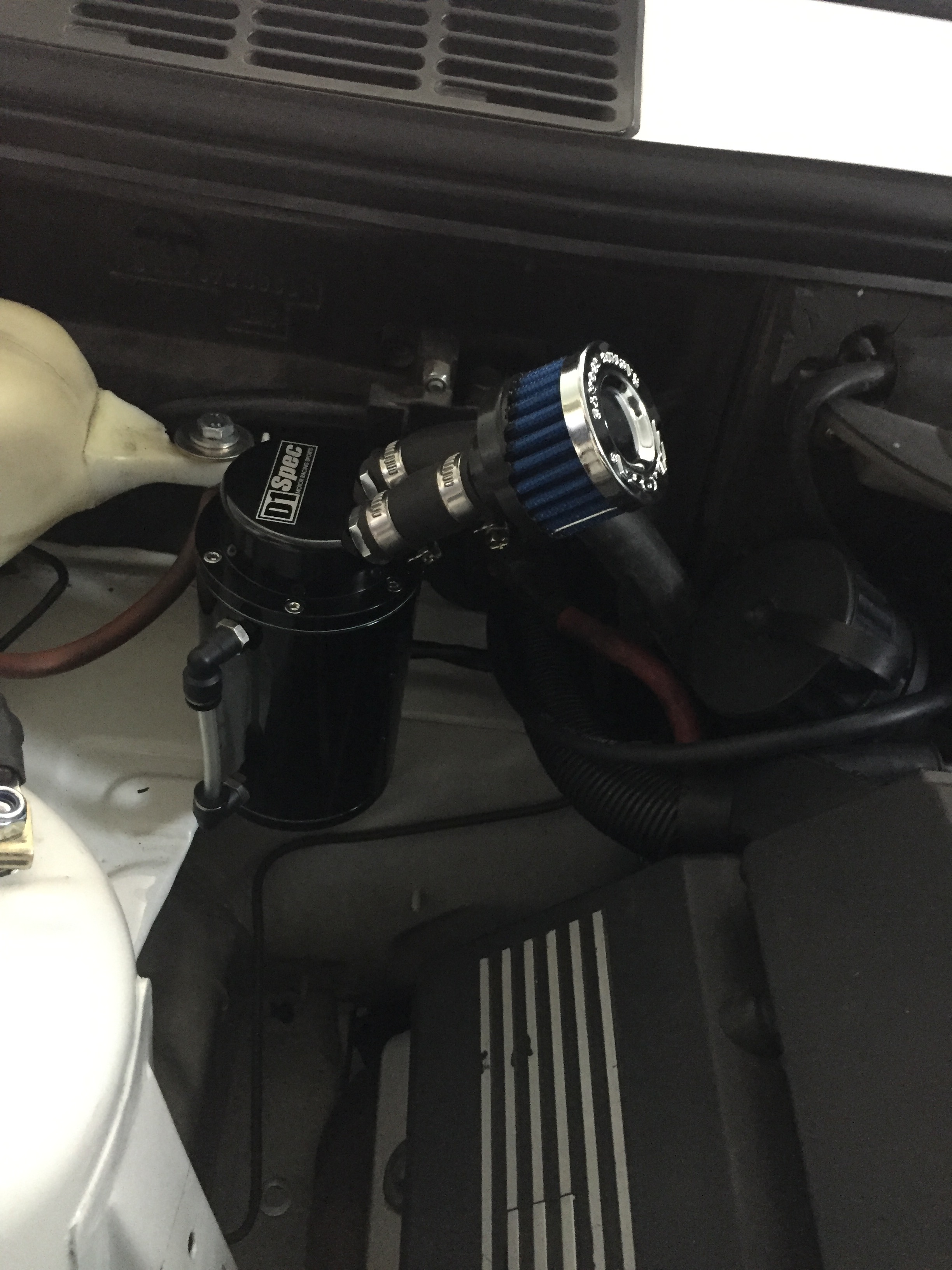
One option is to bypass the stock PCV valve, and install an oil catch tank for residual gases. This can be done by modifying the stock PCV valve, and rerouting gasses to the tank. Other option is to purchase a new rear plate for intake manifold. The oil catch tank was acquired from BjörkMotorsport.
Rerouting a stock PCV valve for external oil catch tank.
The factory has provided four different intake manifolds for M60 and M62 engines. If you have studied about airflow, its obvious to select the manifold with the best possible velocity stacks for optimizing the engine performance. Velocity stacks – also called as trumpets, horns or bellmouths – can increase maximum airflow approx 2-4 %, but the benefit may be even higher in mid-range torque due to intake resonances. The science behind trumpets is their ability to smooth out incoming air, maximizing airflow to intake runners.
Source: Wikipedia, Velocity stack detail.gif, credit for user Motorhead. Picture published under GNU Free Documentation License. Delivery ratio of 387mm long runners with and without bellmouths. The difference is up to 4% gain.
Disclaimer: tuning a naturally aspirated engine is as strong as its weakest link. Cams, valves, cylinder head, headers, collector – and most definitely “the hot air intake system” may be hindering down the power and torque in your build. Thus, the benefit of changing the manifold depends on both level and quality of modifications you have made for your engine.
Different intake manifold versions
M60B30 and M62B35 – These are with smaller runners, so we will forget these,
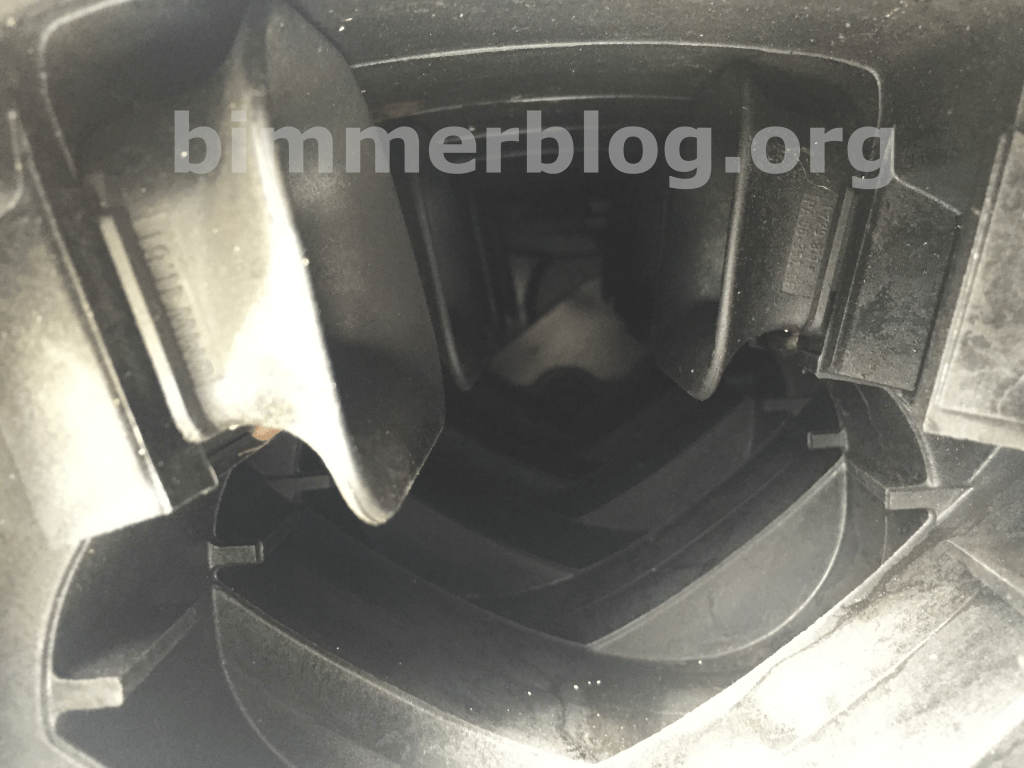
M60B40 model year 1992 (MY1992) – The best version, large runners with full 360° trumpets,
M60B40 model year 1993 -> M62B44 non-Vanos (NV) – Large runners with partial bellmouths at the intake entry; the second-best option,
B62B44 Vanos – Version with small runners, so we will forget these too.
The Intake Battle: MY1992 vs. NV intake
Runners on the NV intake are 387mm long, meaning they are 20mm shorter to MY1992. This suggests that the NV design may perform better at high rpm. Let’s do some analysis, and break it down into numbers:
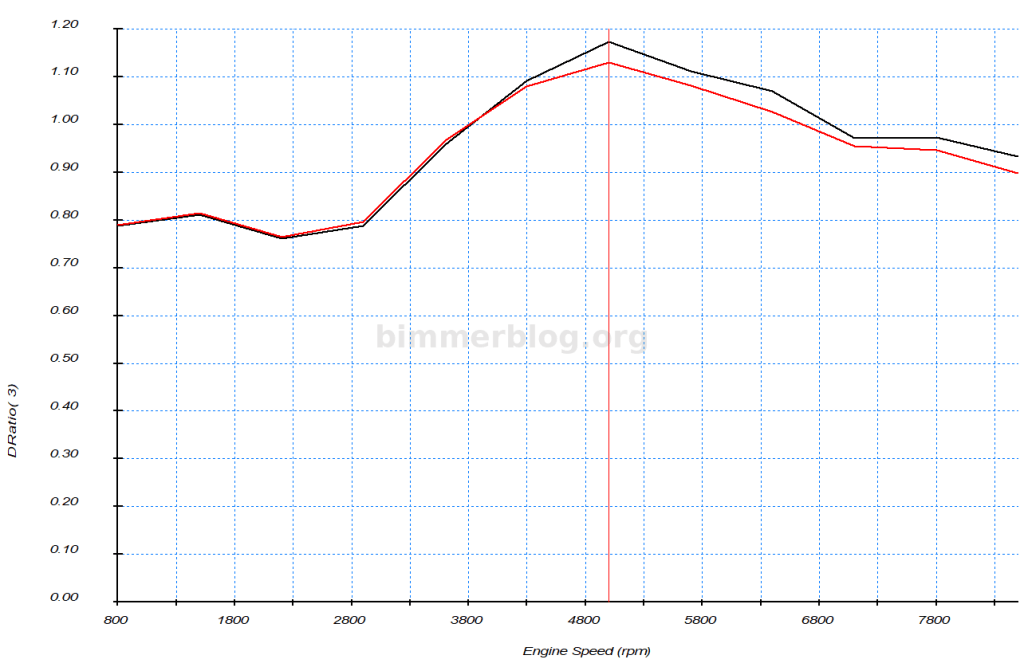
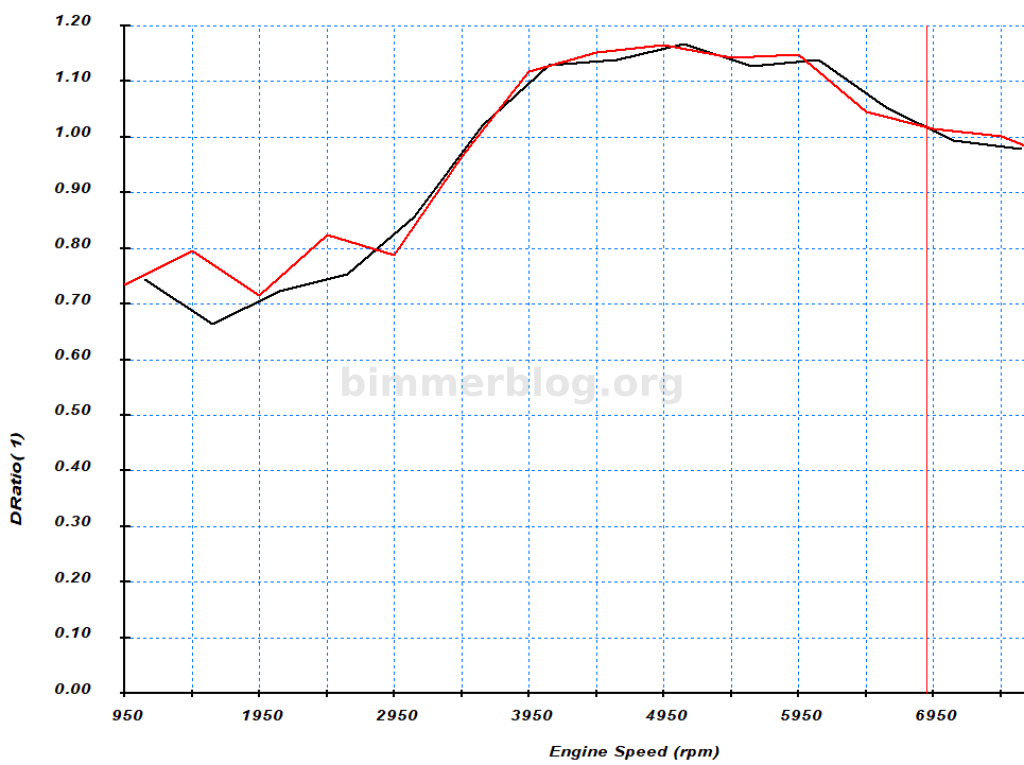
Delivery ratio comparison in cylinder 1. Red = MY1992 intake, Black = M62B44 NV intake.
The MY1992 intake vs the NV:
+Up to 20nm gains in the 1000-2800rpm range,
+Better mid range torque in the 3750-5000rpm range,
+ Up to 8hp higher power output in the 6900-7600rpm range.
The NV intake vs the MY1992:
+Up to 9hp benefit in the 6000-6800rpm range.
The verdict:
Overall, the MY1992 intake is the best choice for a Stage 3 hot street engine operating across a broad 1000–7600 rpm range. The MY1992 intake also shines with automatic transmissions. Intake pulse charging (delivery ratio) is higher on the MY1992 intake due to longer runners, and better velocity stacks (less flow friction). The NV intake has a better delivery ratio in the 6000-6800rpm range, though.
A) If you want the broad rev range (without variable intake) all the way to the 7600 rpm limiter, the MY1992 intake is your best choice.
B) If you have a stock engine with the stock rev limiter and want more top-end grunt, the NV intake is the right one for you.
Visual identification
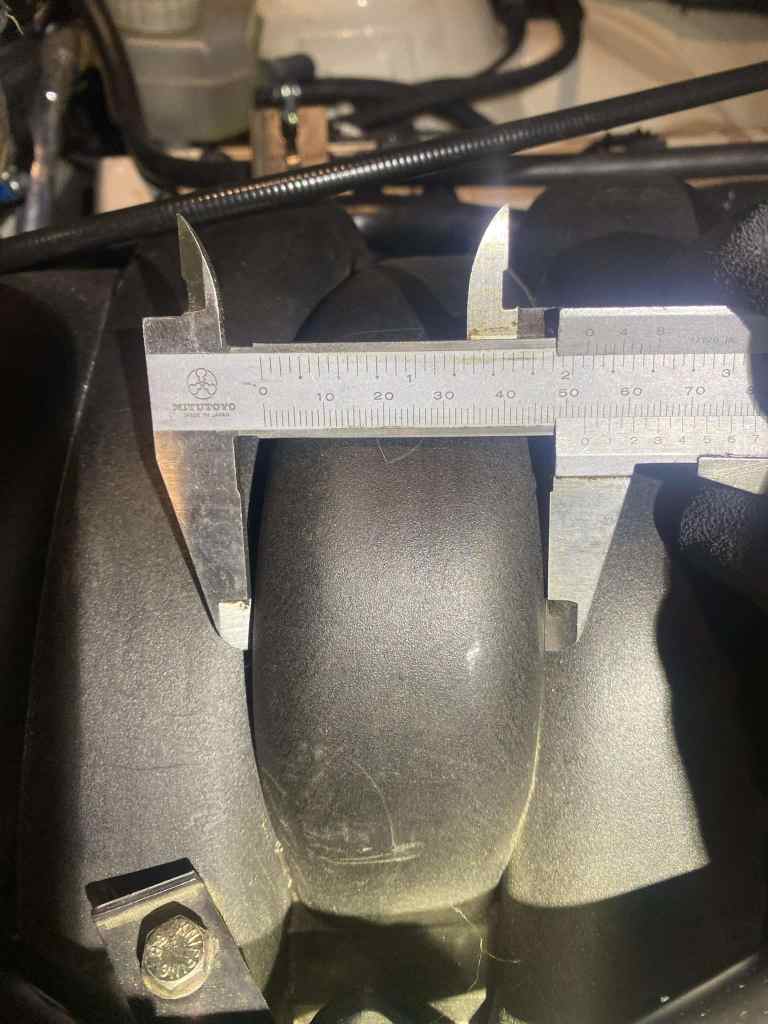
M60B40 intake manifold has bigger diameter runners. The outside diameter is 53mm.The best option: Ultra rare M60B40 model year 1992 manifold with proper velocity stacks for maximum air flow.The second best option: M62B44 Non-Vanos (NV) intake. Note the pipe in the middle for distributing blowby gasses more evenly to all cylinders. You can read more information about Crankcase ventilation design fault from the other blog article.
There are four hypothesis, why BMW quit developing 1992 version of the manifold so soon:
Factory may have wanted the best possible features and grunt for the press, when the new M60 V8 engine was introduced.
Guys at the department of finance wanted to cut some costs. We know how expensive these engines are to build. Take for example M60 timing gear with duplex chain. The level of design and robustness is closer to a tank.
Velocity stacks are prone to get loose. Simply put – why bother, if you can cope without them, and avoid any warranty issues.
Please take a note about sourcing the best throttle body for your M6x build. There is different TBs as well:
M60B30: 70mm with a wedge,
M60B40: 80mm with a wedge,
M62B44NV: 80mm without the wedge,
M62B44TU: 80mm without the wedge (EDK),
N62 throttle body: 84mm without the wedge (EDK).
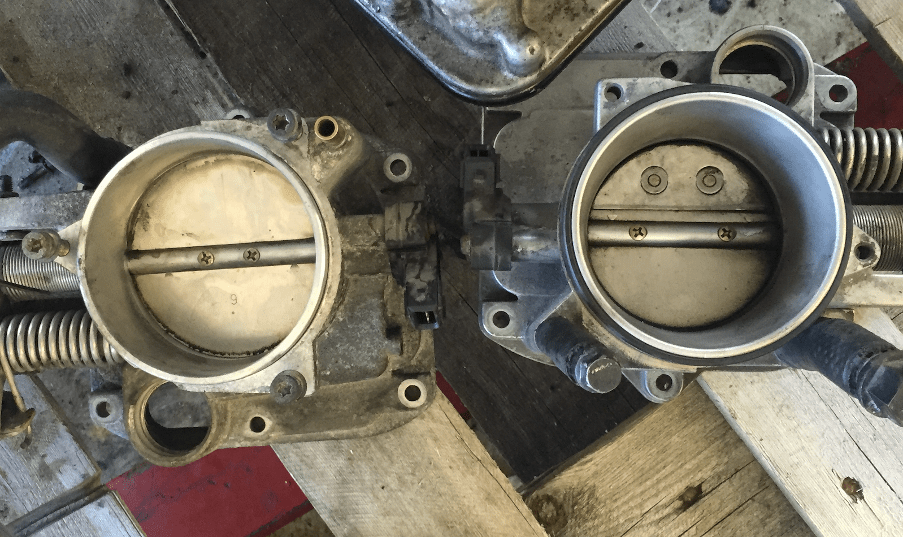
The first three aforementioned are cable controlled versions, and the latter are with electric throttle valve (EDK). The best cable driven 80mm throttle body is from M62B44 non-Vanos (NV) engine without the wedge. 80mm non-wedge versions will do just fine on a typical M60B44 build with no flow penalty. See the picture below to identify one:
Comparison of stock M6x throttle bodies. Left: The preferred, cable driven 80mm throttle body from M62B44 non-Vanos engine. Right: M6x throttle plate with the wedge (Flow restriction at WOT) can be identified from the rivets on a throttle plate.
Still here? There is more information about performance upgrades on my other articles:






 BimmerBlog.org