Have you ever wondered the effect of differential gear ratio to real-world performance? How about transmission gear ratios? Read on!
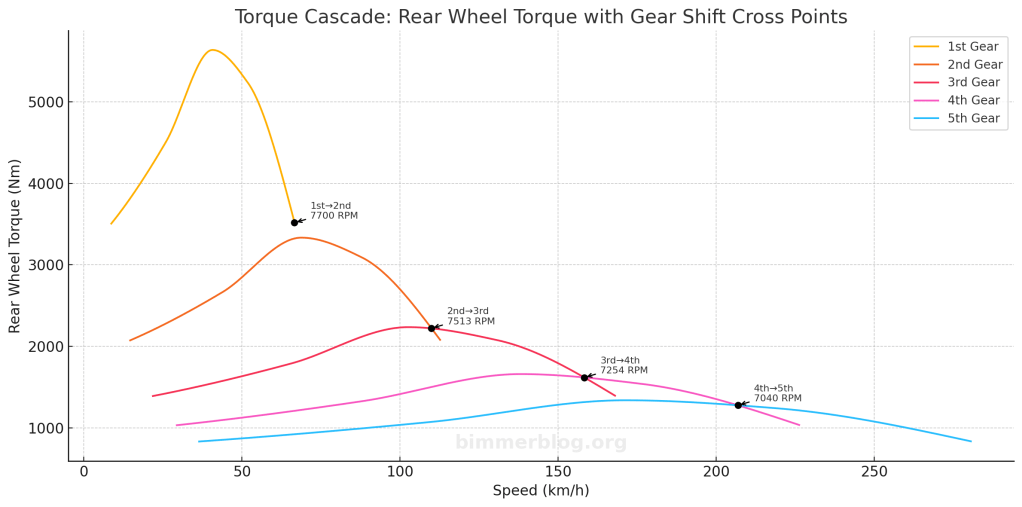
The chart above is illustrating how much actual torque rear wheel is transferring to ground. When you upshift, the amount of torque decreases in relation to transmission gear ratio. The best acceleration is achieved by maximzing the area under the torque cascade.
The formula for rear wheel torque is:
Engine torque * Transmission gear ratio * Diff gear ratio * Powertrain loss = Torque on the rear wheel
As you can see from the formula, there is four options to optimize your vehicle’s rear wheel torque. Too often only max hp numbers are being taken into account. Best engines can tackle this challenge by providing wide torque and power band. This approach increases usable rev range. The next challenge is to match your engine’s power band with transmission, and diff ratio. This is where torque cascade, the chart above, becomes handy. In modern cars, most factories tackle this issue by having 7-9 speed transmissions. This is also the reason why so many car enthusiasts are interested in 8HP transmission swaps. However, putting a cheap manual transmission from a diesel car is not really an option. As you can see from the cascade chart, an engine with wide power band needs longer first gear, not shorter. Subjectivity is big factor here (manual, auto, DKG), so choose your path wisely.
 BimmerBlog.org