Have you ever wondered the effect of differential gear ratio to real-world performance? How about transmission gear ratios? Read on!
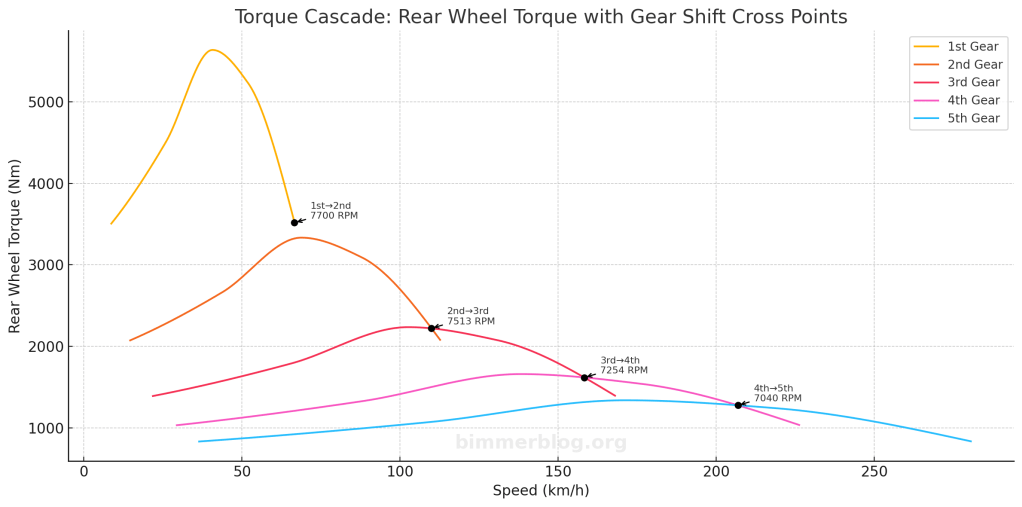
Your engine is torque generator, while transmission is torque multiplier. This chart is illustrating optimal shifting points for maximal acceleration on high performance engine with manual transmission.
The chart above is illustrating how much actual torque rear wheel is transferring to ground. When you upshift, the amount of torque decreases in relation to transmission gear ratio. The best acceleration is achieved by maximzing the area under the torque cascade.
The formula for rear wheel torque is:
Engine torque * Transmission gear ratio * Diff gear ratio * Powertrain loss = Torque on the rear wheel
As you can see from the formula, there is four options to optimize your vehicle’s rear wheel torque. Too often only max hp numbers are being taken into account. Best engines can tackle this challenge by providing wide torque and power band. This approach increases usable rev range. The next challenge is to match your engine’s power band with transmission, and diff ratio. This is where torque cascade, the chart above, becomes handy. In modern cars, most factories tackle this issue by having 7-9 speed transmissions. This is also the reason why so many car enthusiasts are interested in 8HP transmission swaps. However, putting a cheap manual transmission from a diesel car is not really an option. As you can see from the cascade chart, an engine with wide power band needs longer first gear, not shorter. Subjectivity is big factor here (manual, auto, DKG), so choose your path wisely.
One mile acceleration is the ultimate performance car test.
1609,344 meters. One mile acceleration may never get any attention on mainstream car magazines, but in reality it is the most demanding performance test on any motor vehicle, including electric cars.
Reasons why One mile acceleration is the ultimate performance car test:
One mile acceleration creates the most demanding load on your engine vs. any other performance test such as quarter mile, 0-100km/h, or 0-200kmh etc. Prolonged heat accumulation (BTU) during the one mile run can have drastic results on your car’s performance, and durability.
Since the test is very demanding – and dangerous – it is performed only on closed tracks such as airstrips. CAUTION: Never try one mile run on public roads.
Although my car is designed as cafe racer, not on drag strip, I was interested to see what is M60B44 engine’s real world performance. On one mile run you can compare your car against a vast array of other performance cars. I was lucky to be able to test performance of my E30 on airstrip. I was planning ahead two shifting point scenarios:
The secret sauce for high performance is the torque band on rear wheel, divided by your car weight.
SCENARIO 1: Shifting on maximum torque:
1st to 2nd gear on 7500 rpm @65 km/h,
2nd to 3rd gear on 7500 rpm @110km/h,
3rd to 4th gear on 7000 rpm @152km/h,
4th to 5th gear on 6500 rpm @191km/h,
RESULT: One mile acceleration top speed: 253 km/h @6950rpm
VERSUS:
SCENARIO 2: Shifting on maximum rpm:
1st to 2nd gear on 7500 rpm @65 km/h,
2nd to 3rd gear on 7500 rpm @110km/h,
3rd to 4th gear on 7500 rpm @164km/h,
4th to 5th gear on 7500 rpm @220km/h.
RESULT: One mile acceleration top speed: 254 km/h @7000rpm
ANALYSIS:
One km/h difference between the tests is pretty much negligible. The possible reason is increased tyre pressure after the first run. Subjectively I felt shifting is performed too late on scenario 2, although it yielded into better top speed. M60B44 engine has amazing torque band, so it really doesn’t matter when you change to fifth gear. On the same day, my naturally aspirated E30 was able to beat much higher performance cars due to 26 C weather – since turbocharged cars running on petrol were clogging due to heat accumulation. Cars running with ethanol (E85) were not facing this issue though. Tesla Model S was one of the biggest disappointment with top speed on 230 km/h range. It was pretty staggering to realize the difference in between advertised hp vs. real world performance.
PS. There was a notable side wind on the airstrip, and organisers did indeed gave a warning to motorbikes about the pesky wind. Nevertheless, I did not noted any side wind issues on E30 whatsoever, although the wind on the above video is substantial. A few really understand how seriously stable car E30 with M-technic 2 aerodynamic package is to drive at high speeds. There is so much reason why E30 is legendary. E30 is pretty much beating all never cars (read: heavier) in driving response, and feel. Due to its light weight, it just goes like a thought. It is much better than 335 M-Sport, which I did not felt comfortable at all to drive due to pesky side wind. 335 is just too heavy, rear axle gets slump, car lacks top speed stability, and it is nowhere as nimble on twisty roads as E30.

 BimmerBlog.org