Here’s quick Cheat Sheet to E30 front geometry. The table below presents a comparison of various E30 front suspension setups, normalized to a baseline where the control arm is horizontally aligned. This allows for accurate comparison of caster, camber, and wheel position. The baseline setup uses E30 control arms, stock spindles, and hubs.
Caveat 1:
Lowering your E30 too much affects negatively on roll center (more body roll), dynamic camber development (less grip on corners) and bump steering (toe changes on bumps).
Caveat 2:
Any lower control arm and/or spindle change that moves the front tire rearward, negatively affects on the suspension geometry parameters.
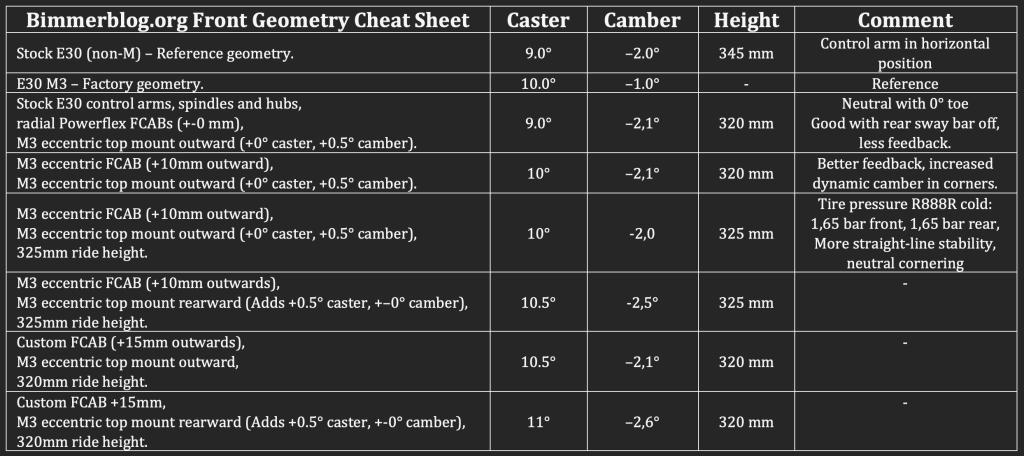
Base Setup in the table:
– Control Arms: Stock E30 non-M,
– Steering Rack: E36 with modified subframe brackets,
– Front Control Arm Bushings (FCAB): E30 M3 Evo-style eccentric,
– Top Mounts: E30 M3 eccentric,
– Stock E30 spindles and wheel hubs.
The easiest way to maintain good handling..
A) Don’t lower your E30 too much — avoid letting the control arm point upwards,
B) stick with the stock E30 lower control arms (LCAs), spindles and hubs,
C) Maybe it’s not the front end? Try disconnecting the rear sway bar (!).
Changing the Front Control Arm Bushings (FCAB)
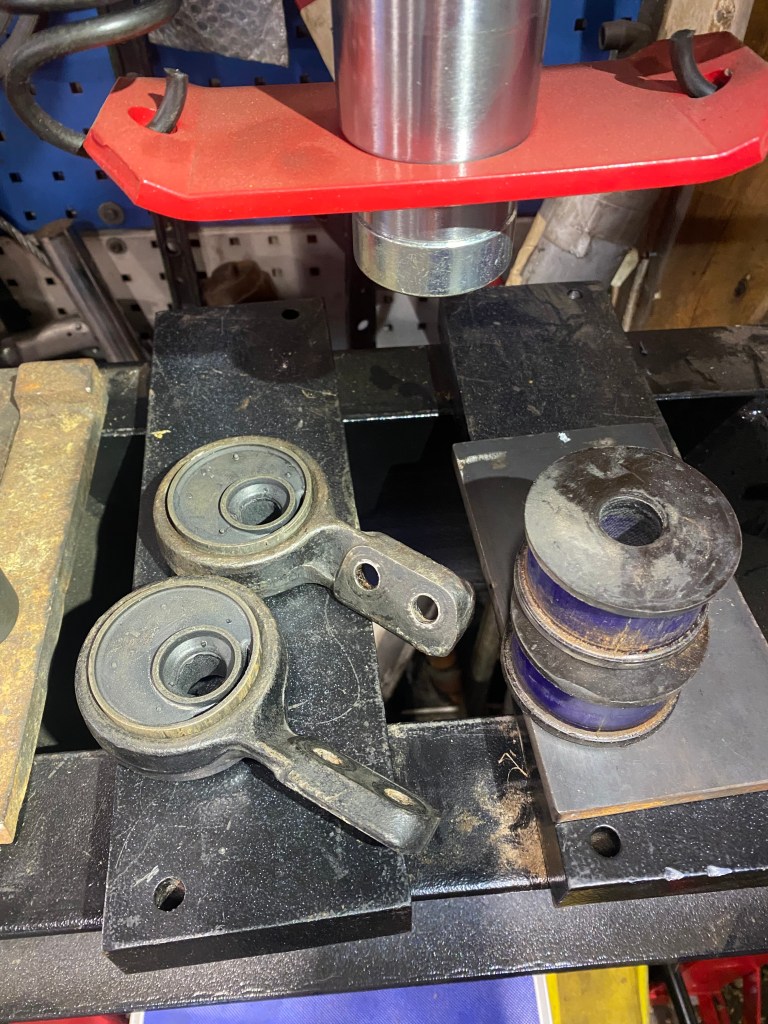
I changed Powerflex centric bushings to M3 Evo eccentric ones. There’s notable difference when increasing caster from 9 deg to 10: more straight-line stability, better feedback, and increased dynamic camber in corners. The change from Powerflex bushings to M3 evo eccentrics is highly recommended. Powerflex are hand tight to lower contol arms (LCA), whereas Evo bushings needed a custom tool.
Bushings 101
- BMW engineers knew what they did when designing M3 evo FCABs,
- Think twice before installing billet FCABs and top mounts on the street – both cause excessive NVA (Noise, Vibration, and Harshness) and stress to the chassis,
- Stick with Powerflex and/or M3 evo FCABs on the street.

Useful links:
Geometry correction kits and comprehensive front suspension guide : https://mrtengineering.fi/
VSusp.com – Suspension Geometry Simulator: https://vsusp.com/

 BimmerBlog.org